2011
In May of 2011, the USFWS - Willamette Valley National Wildlife Refuge Complex Partners for Fish and Wildlife Program prepared the "Wetlands Reserve Plan of Operations" for nearly 100-acres to be located in the future perpetual conservation easement. Following are excerpts from this document.
Historic Conditions:
"Prior to Euro-American settlement, the Wetland Reserve Program (WRP) easement area was likely a mosaic of native wet prairie and upland prairie -- Oregon white oak savannah, with inclusions of emergent marsh scattered throughout. Drainage ways would likely have been comprised of wet prairie, pockets of riparian forest, meandering slough/creek bottoms and beaver ponds."
Current Conditions:
"Current riparian vegetation is limited to narrow field edge strips (hedgerows) comprised predominantly of Oregon ash and black hawthorn.
"Native vegetation has been cleared for decades on this site...creek bottoms have been ditched and/or incorporated in the Santiam Water Control District delivery system. There appears to be little to no evidence of drain tiling which offers the promise of cost-effective high quality hydrologic restoration potential."
Habitat Goals:
"The restoration of large blocks of native prairie and savannah habitat presents an opportunity to achieve significant conservation gains for numerous taxa in decline. This may include rare plants, grassland birds and pollinators.
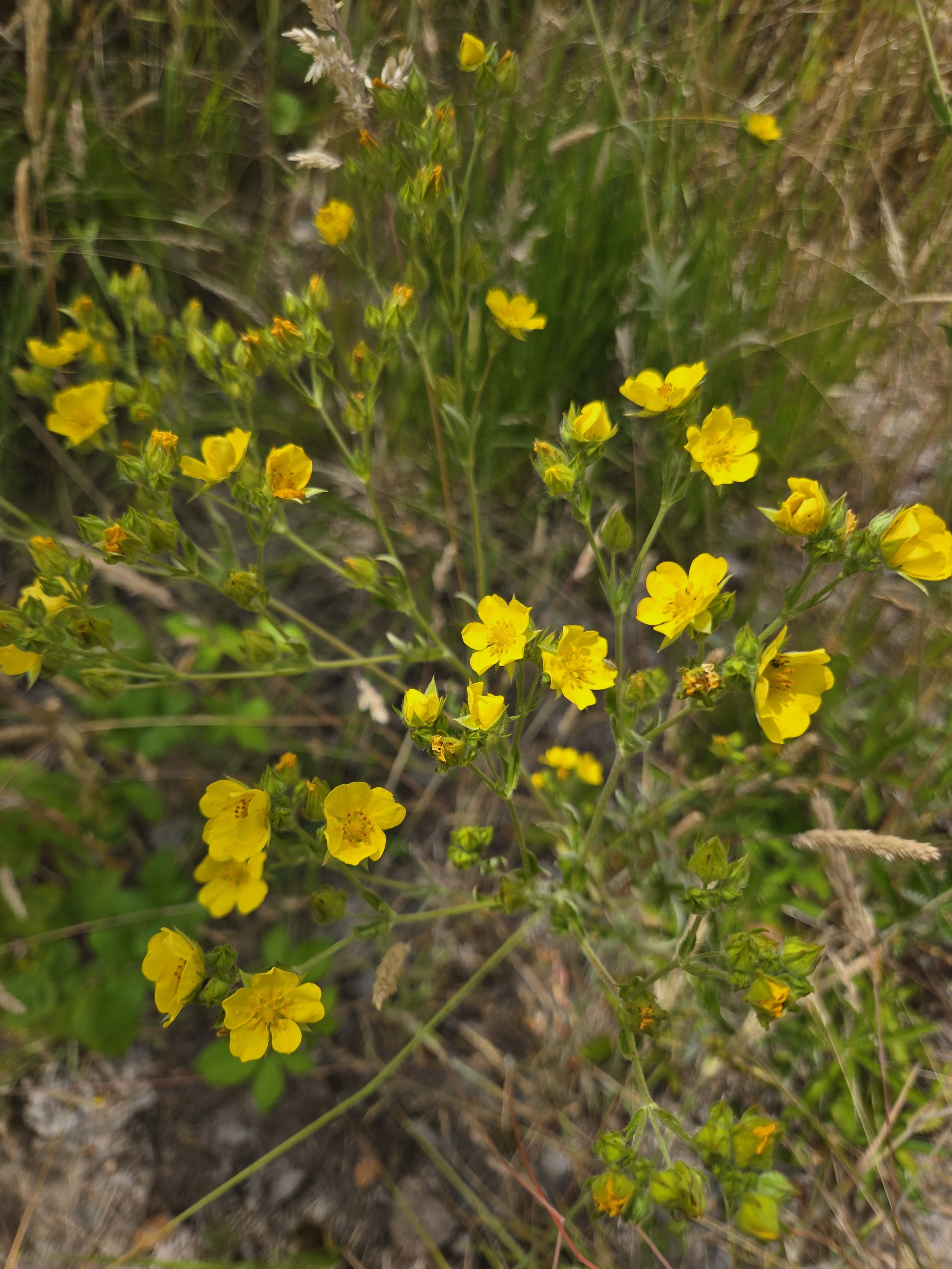
"A partial list of plants that may benefit includes: Meadow checker-mallow, Oregon sunshine, Self heal, Graceful cinquefoil, Cat's Ear lily, Common camas, Nelson's checker-mallow (threatened), Narrow-leaved mule's ears, Oregon geranium, Oregon saxifrage and Slim-leaf onion.
"Avian species of conservation concern may include the Western meadowlark, Streaked-horned lark, Grasshopper sparrow, Oregon vesper sparrow, Northern harrier and Short-eared owl. Suitable habitat may be restored that could present options for introduction of Willamette Valley daisy (endangered) and Bradshaw's desert parsley (endangered).
"These conservation efforts will directly support the implementation of the Oregon Conservation Strategy, Recovery Plan for Prairie Species of Northwest Oregon and Southwestern Washington, and Partner's in Flight Strategy for Landbirds of the Lowlands of Western Oregon and Washington."
Restoration Plan:
Habitat types being restored are wet prairie (approximately 2/3 of acreage), upland prairie (approximately 1/3 of acreage) and sporadic assortment of fresh water marsh throughout the site.
Historic Transition from Crop Ground to Wetland:
On October of 2011, the ground was leased for the production of sweet corn which was processed by Norpac Foods in Stayton. After nearly 100-acres were placed into the Wetland Reserve Program, crop production continued with sweet corn and beans on the remaining 18-acres of crop ground which was converted to "certified organic" after a 3-year phase in period from 2011-2014.
Photos below give an idea of the intensive use of the land prior to the ten year conversion process.

Sweet corn in northwest field.

Harvesting sweet corn, October, 2011.


November of 2011. Conservation Boundary Easement sign posted. Behind is field where sweet corn was harvested.

2012

Les Bachelor, District Conservationist, U.S.D.A. Natural Resources Conservation Service, develops conservation plan for Santiam Valley Ranch.

Properties are surveyed and marked as U.S.D.A. Wetland Reserve Program.

Sloughgrass (Beckmannia eruciformis)

Fool's Onion (Brodiaea hyacinthina)

Red-legged frog

Western pond turtle

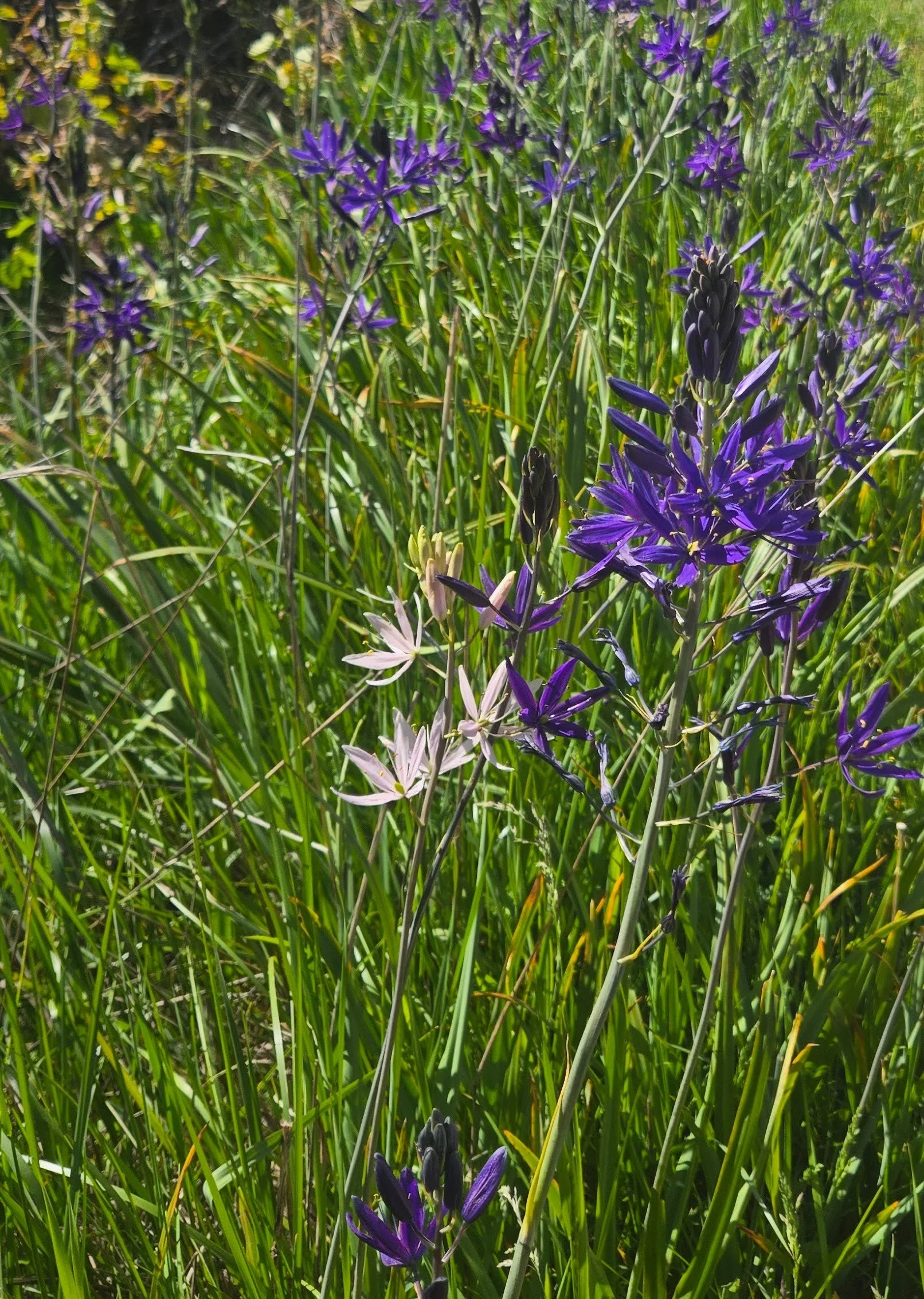
Camas (Camassia spp.)

Santiam Valley Ranch has red borders; the WRP land is in green. Two additional landowners participated, and are identified by blue and purple borders. All total, approximately 400 acres were enrolled with the U.S.D.A. Natural Resource Conservation Service in the Wetland Reserve Program to re-establish wetland prairie and upland prairie.

2013

Chris Seal, U.S. Fish & Wildlife Service, Kathy Bridges and David Stroppel, Oregon Department of Fish & Wildlife, meet in March to discuss project options. In the truck behind them are empty containers which previously contained plugs of various wetland plants.
Representatives from U.S. Fish & Wildlife Service discovered nesting Streaked Horn larks on the northeast field. Because this bird is listed as "threatened" all activities in this area were put on-hold until solutions were found on how to restore the site without using equipment or herbicides. Restoration in this area began in 2014, following the nesting season.
Restoration activities included removal of fence and trees, thus creating open prairie. Irrigation pipe that was once abandoned in the field was found and removed, along with steel fence posts. Herbicide was applied too late in the season so control of vegetation was extended.

Fences removed from two properties on NW field-- left is Santiam Valley Ranch where the sweet corn was raised.

Irrigation pipe abandoned along the fence line was removed.

Shrubs and trees along the fence lines were removed along with the fence.


Removal of trees and fence on NE field and initiating contours creating wetland berms and seasonal ponds.
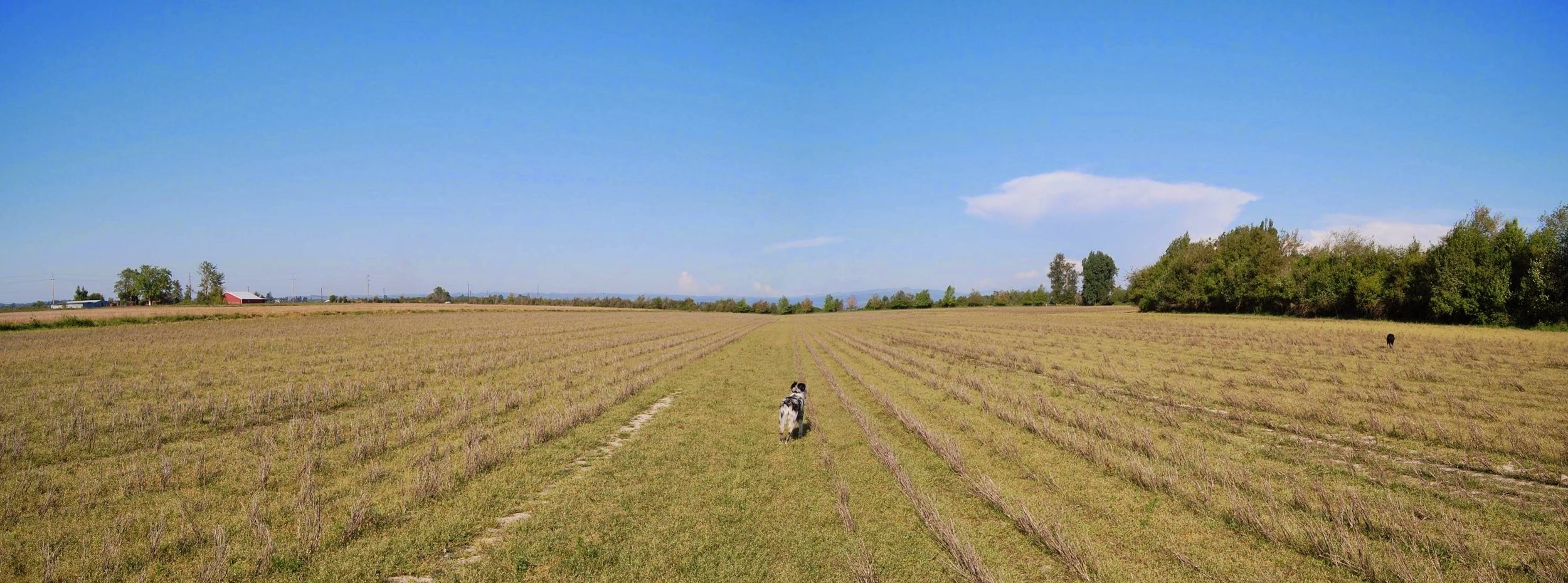
Left and right are the same NW fields. Above shows field where the sweet corn was raised in 2011. The field was later sprayed with herbicide (note in photo on the right) to kill all plants with the goal to prepare a clean field for planting of wetland forbs. After establishment of the forbs, the fields will be supplemented with native grasses, largely Tufted hairgrass.


Equipment is moved in onto the NE field. Equipment used: scrapper, two bulldozers, grader, excavator, and two tractors with mower and disc.

July begins work with dozers and scrappers to contour land for wetland.


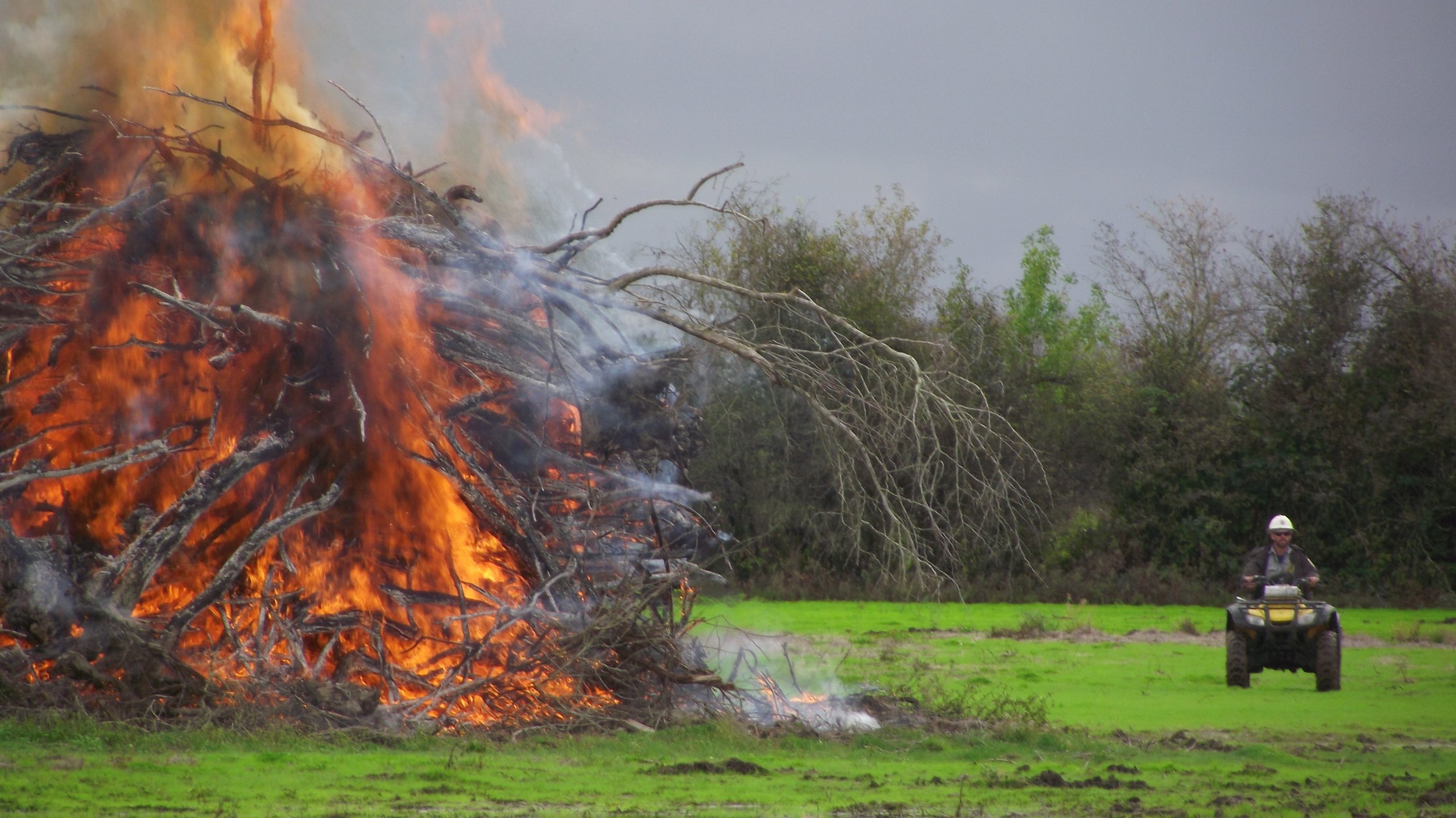
During September, the tree residue is burned. The site is cleared from trees, fence posts, irrigation pipe and set to be restored to native wetland prairie.


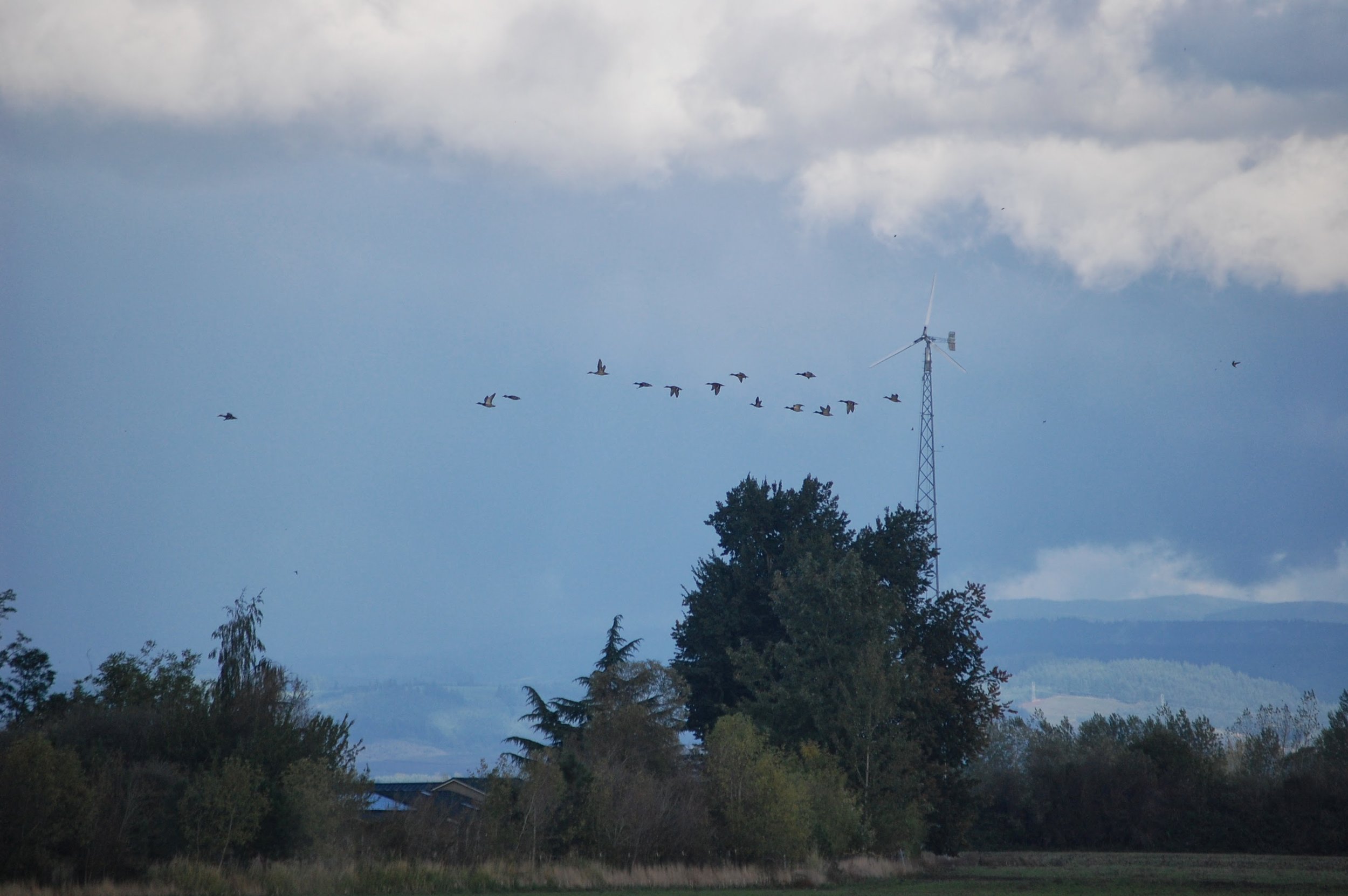
As the year ends, migrating waterfowl return to Santiam Valley Ranch.

October: Canada and Snow geese return to Santiam Valley Ranch.

2014
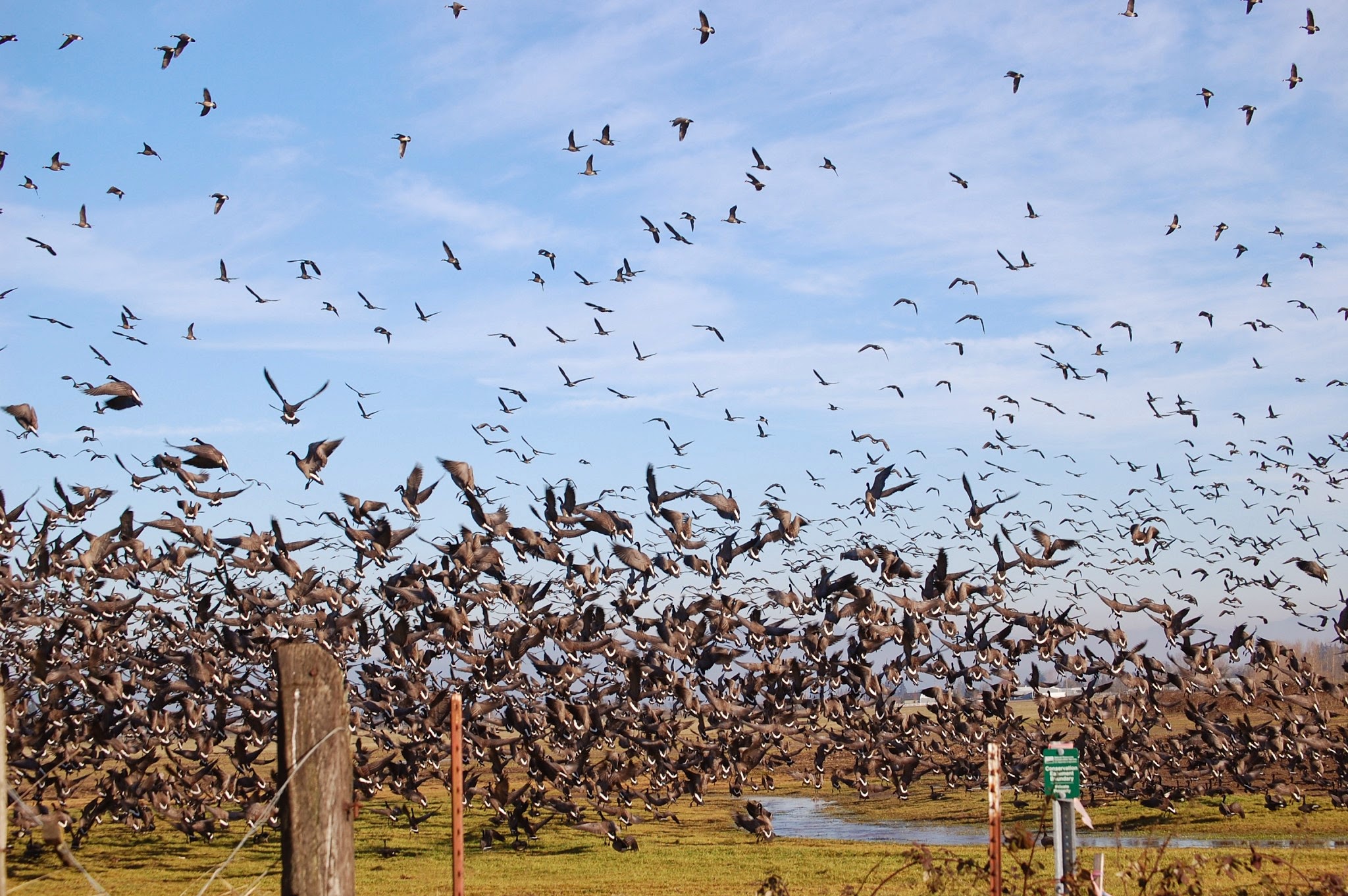
Canada geese and Conservation Easement Boundary on right.

2014 LIFE AT SANTIAM VALLEY RANCH.
Waterfowl migration abounds each year at Santiam Valley Ranch.

Trumpeter swans with Mt. Jefferson on right.

Proposed wetland area is mowed, sprayed and/or disked.
This is from the NE corner of the wetland area.

NE corner of wetland area. The berms have been mowed. Some disking has occurred in low-lying pool areas.

NE corner field. Berms have been mowed, Pool areas still hold water in August from the past winter rains.
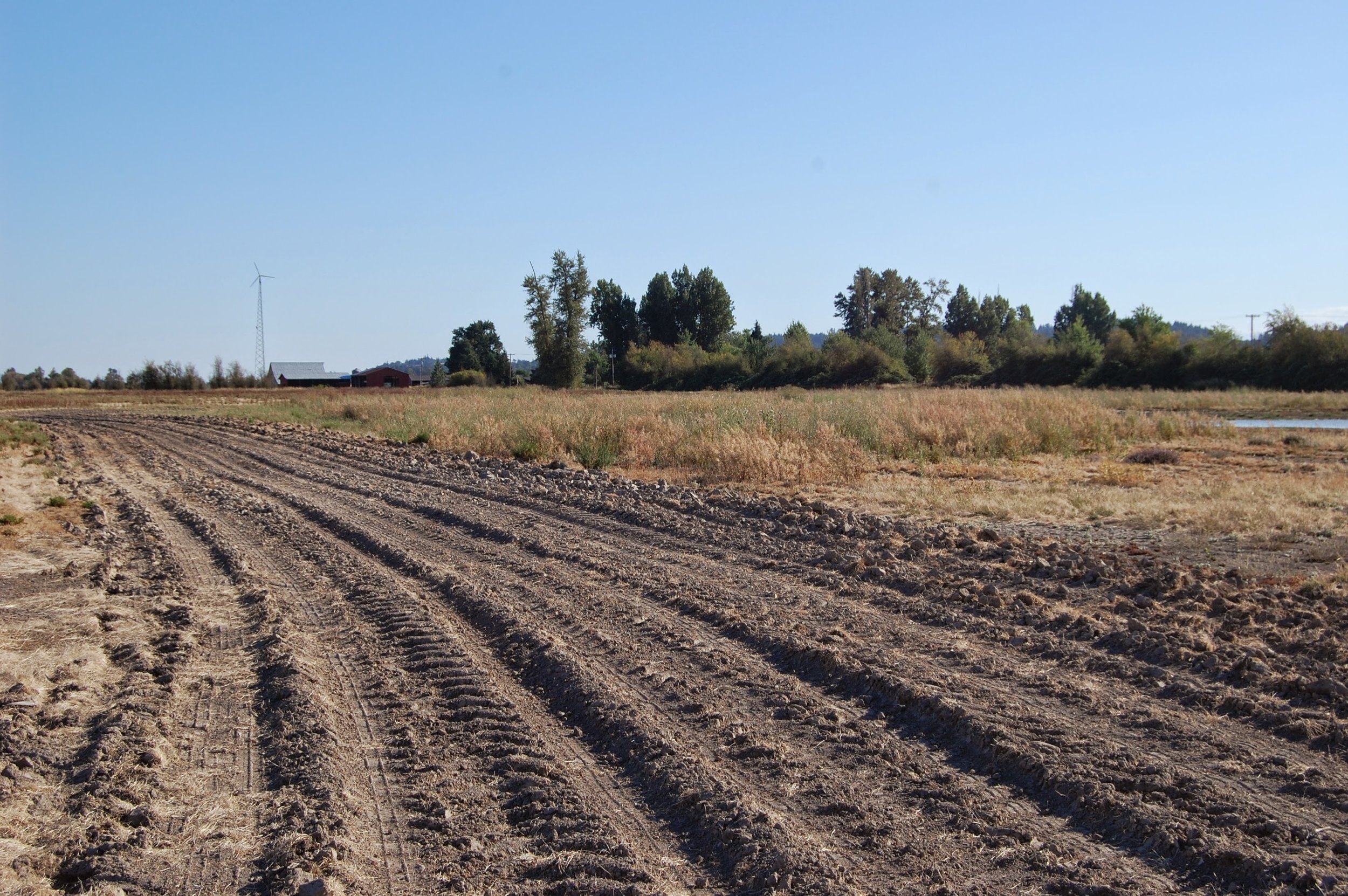
NE corner field. Disking in selected areas.

SW field completely disked on upper area.

NW field being mowed. Field is infested with non-native wetland species.

NE corner field. Non-native vegetation.
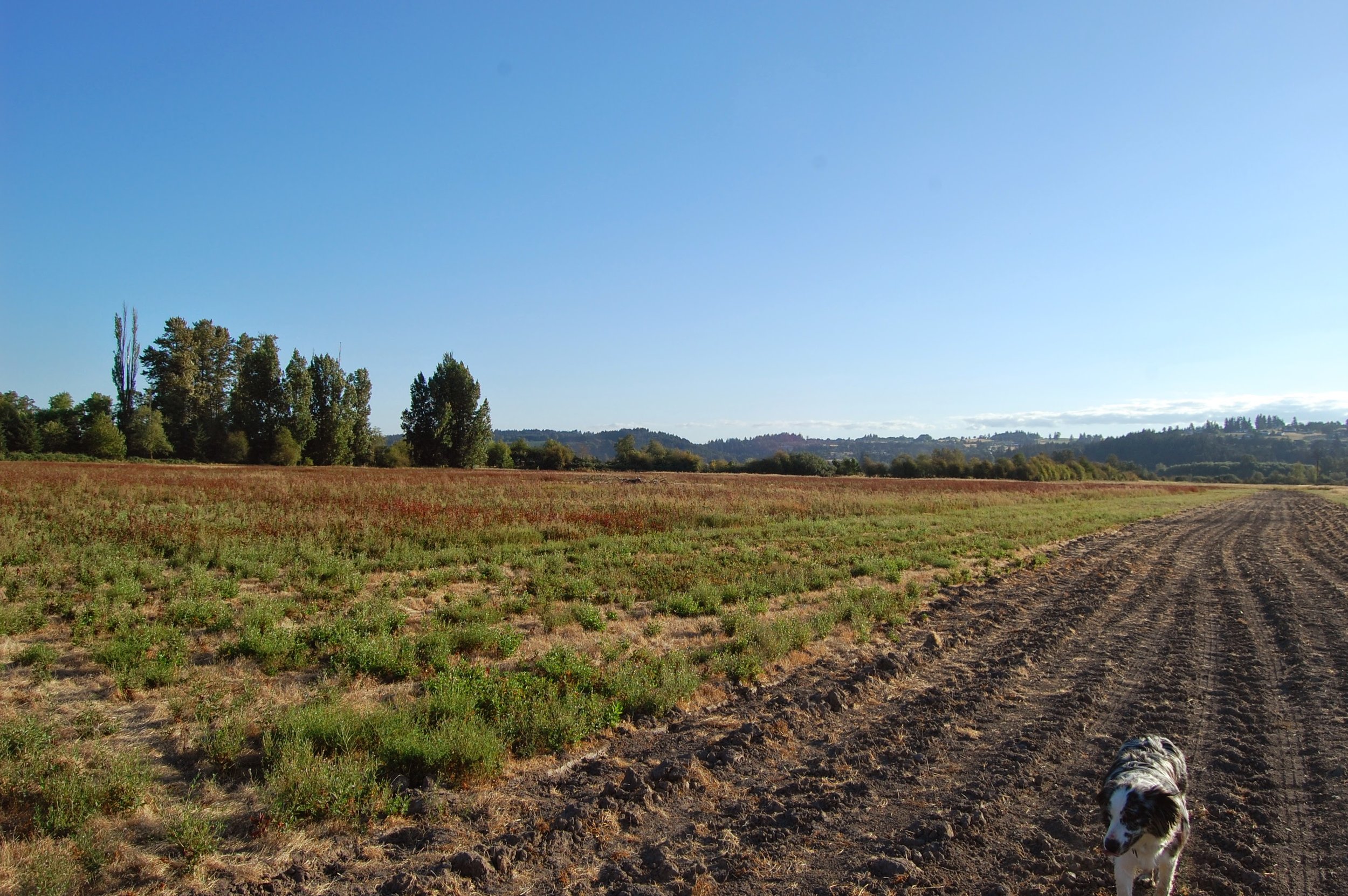
SW field showing area that will be mowed and disking on the berms.

NW field showing signs of pool formation and emerging native wetland species.

2015
Thousands of forbs (herbaceous flowering plants) have been planted during the winter and early spring. Some areas are mowed and other areas are sprayed to kill grasses only. Work continues on the hedgerow on the NE field. There are a few areas on the farm that have not been addressed, including land adjacent to the irrigation ditch and the 8 acre field. Emphasis has been given to the larger pieces of ground, hoping to follow-up with restoration work on smaller slivers of land.

Mowing upland area disking shallow seasonal pool areas.
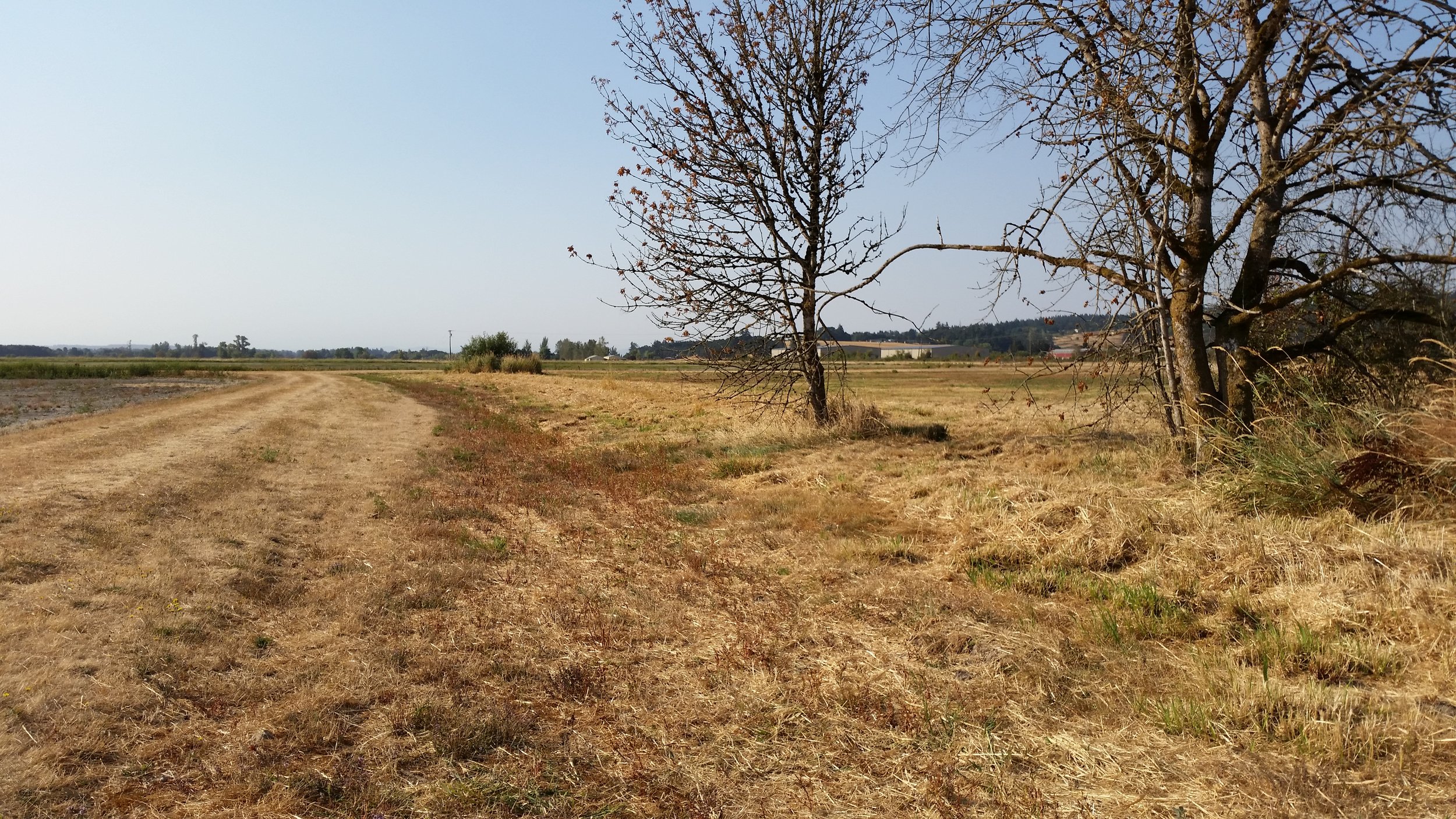
Border line between Santiam Valley Ranch (left) and neighboring property owner to the west.

Looking toward wind turbine from SW field on Santiam Valley Ranch.


Wetland in foreground with organic sweet corn behind.


On 8 acres, mowing in field to control Reed canary grass.

8 acre field where trees were planted by Andy, Luke and Ken.

September, view of NW field.

September, view of SW field

2016

2016 -- A tour of the wetland with Chris Seal, U.S. Fish & Wildlife Service. (Paul Conner, Luke Fitzpatrick, Chris Seal and Ken Dunder)

SW field with seasonal pools filled with Water-plantain (Alisma spp.) and an occasional Bulrush (Schoenoplectus spp.).

June, spraying and mowing continues on the NW field (above and below).


Hall's aster (Aster hallii)

Dense spike-primrose, (Epilobium densiflorum)

NE field venal pools become more established with rushes, Water-plantains and cattails (Typha spp.)

Stinking chamomile, (Anthemis cotula), introduced species from Eurasia

Fragrant popcorn flower, (Plagiobothrys figuratus)
THE TURTLE PROJECT: Kathy applied to Oregon Water Enhancement Board as a partnership between herself and Luke to construct nine small ponds on their adjoining property. The Santiam Valley Wetland Enhancement Project grant was approved providing $10,000, with matching funds provided by Kathy and Luke. Implementation occurred in 2016-2018.
The project relied on “Guidance for Conserving Oregon’s Native Turtles Including Best Management Practices” from The Oregon Conservation Strategy Guidance for Conserving Oregon's Native Turtles 2015. Susan Barnes, Regional Conservation Biologist, Oregon Department of Fish and Wildlife, has been available for technical assistance.

Big Job Protecting Our Western Pond Turtles!
Kathy holding OWEB grant, NRCS WRP Work Plan, Oregon Division of State Lands permit and U.S. Army Corps of Engineers permit.
The project included on-going cooperation with U.S.D.A. Natural Resource Conservation District and U.S. Fish & Wildlife Service so that the completion would be compatible with the larger wetland restoration endeavors. The approved OWEB grant and "Guidance for Conserving Oregon's Native Turtles Including Best Management Practices" was added to the NRCS-WRP work plan for both properties.
IMPLEMENTATION: The project was accomplished by first shaping and contouring the ground to create depressional wetlands of different sizes and depths. Excavated soil was retained on site and used to create areas of higher ground that would remain dry and/or are inundated for shorter duration. Created wetlands will hold water during the wet season and slowly drain to form ephemeral pools during drier periods. The wetlands are to be fed by precipitation and supplemented with water supplied though existing irrigation water rights from the Santiam Water Control District. Water supplementation is to occur during summer months from three irrigation outflow locations. Water is directed to the ponds through very shallow channels which emerge from existing underground irrigation risers. Pumping of water is conducted off-site from the WRP project. Deeper wetland depressions may retain some water year-round depending on precipitation patterns and as allowed through irrigation water management. Wetlands with open water will provide essential habitat and aquatic life resources when the water table is lower in the summer months.
One of the goals was to determine the preference for pond dimensions and structure by the turtle. There were nine ponds created: 1 - 30' x 30' pond, 3 - 15' x 15' ponds, and 5 - 10' x 10' ponds. The small ponds were excavated to a depth of 3-4’ with gradually sloping banks to hold water during summer months.
The soil work was followed by the planting of native wetland species as well as wetland emergents and sub-emergents. Native plantings will attract insects, an important food source for many species of wildlife including turtles and amphibians. Plantings will also provide egg mass attachment sites for Red-legged frog and other amphibians.
The project will provide specific habitat elements for targeted species. Large wood will be placed to create and enhanced the wetland and surrounding upland areas to provide amphibian and turtle basking sites and hiding cover.
Several areas of suitable turtle nesting habitat will be created. This will be accomplished through earthwork and amending existing soils with a gravel component. Soil removed will be used to create nesting sites for turtles. Turtle nesting mounds measuring 20’ x 20’ and ranging from 12” to 36” in height are composed of 25% or less of fine clay, 25% of loan, 25-50% of sand and 25% or less of small aggregate based on recommendations from Oregon Department of Fish & Wildlife.
Invasive plants will be managed/controlled throughout the life of the project.
Construction involved use of scraper, excavator, dozer and two dump trucks.
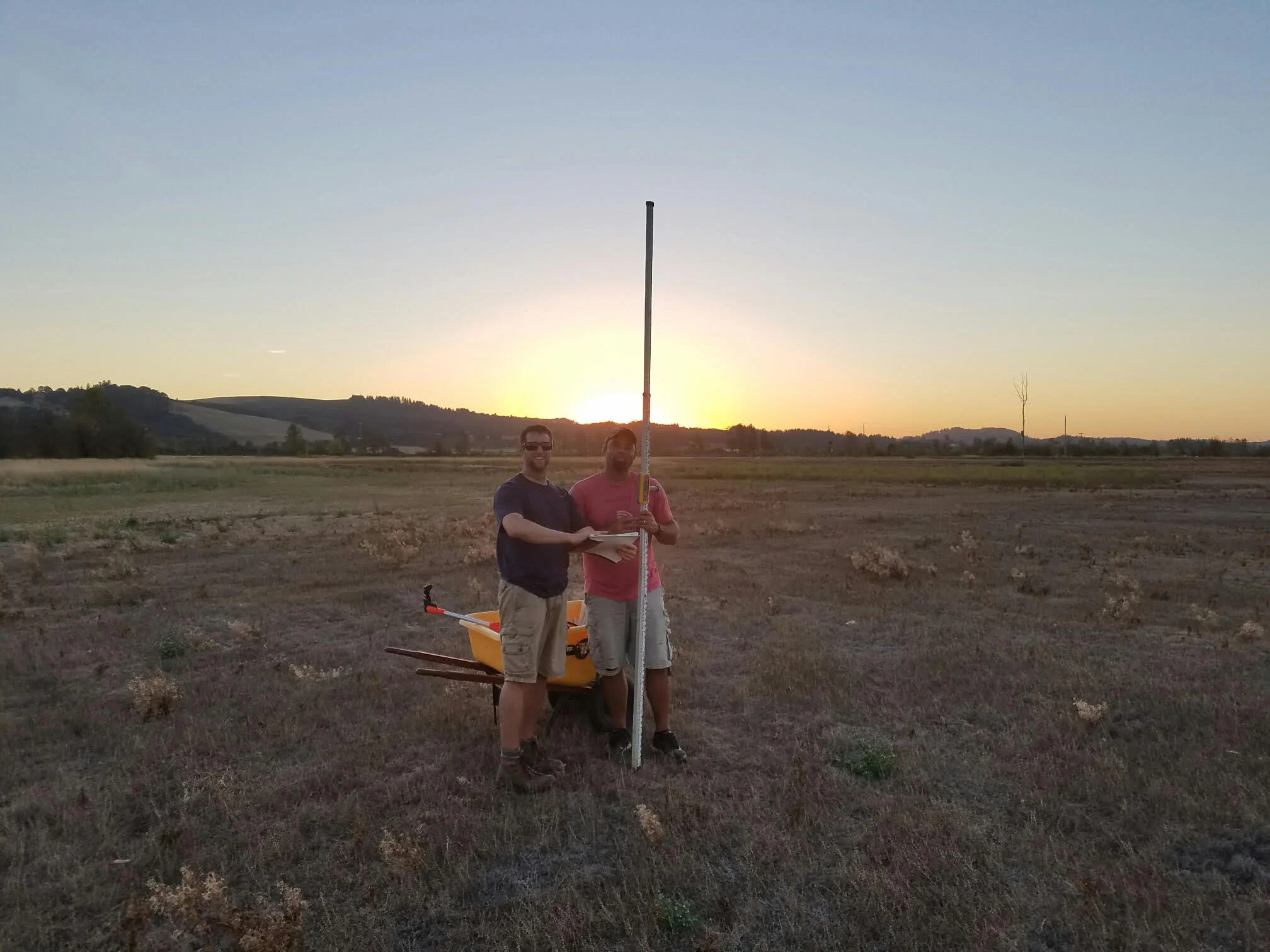
Surveying pond areas.

Specialized aggregate for turtle nesting mounds.

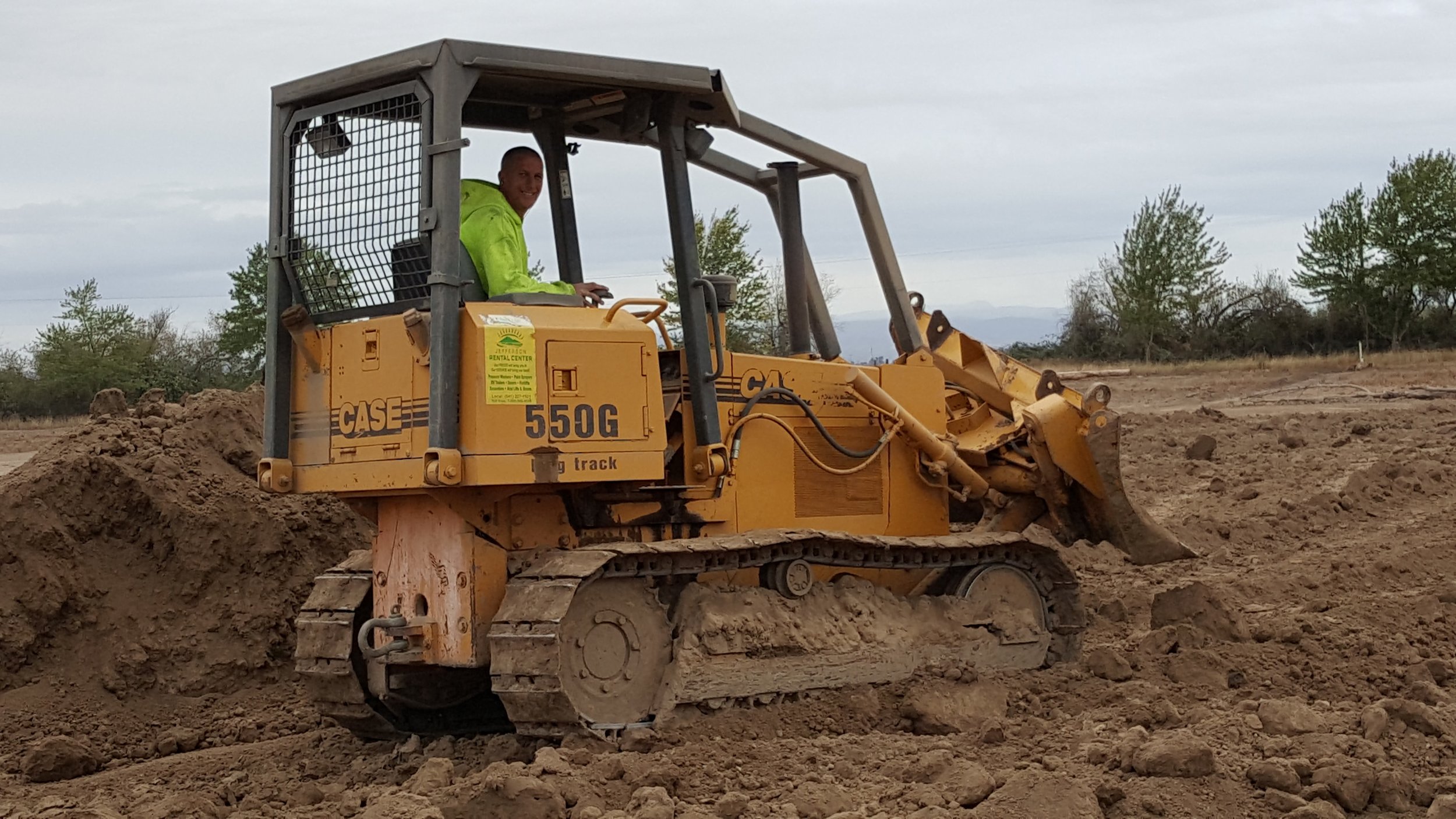


Creating turtle nesting mounds.

Creating turtle nesting mounds.

Maple logs and cobblers for ponds.


Excavator creating turtle pond.


30' x 30' pond near riparian vegetation at Santiam Valley Ranch.
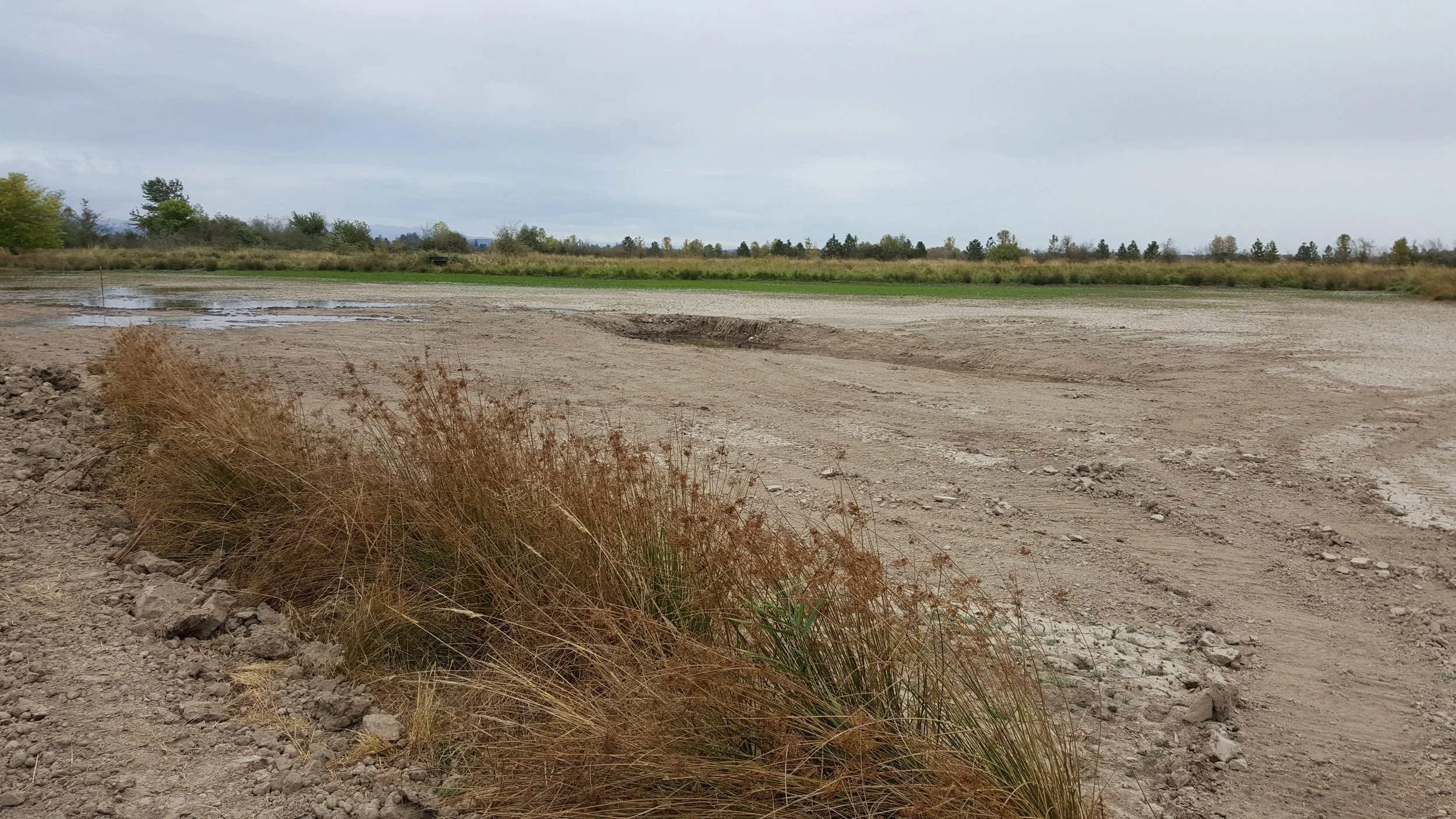

One of three 15' x 15' pond located at Santiam Valley Ranch.

Ken installed the irrigation system to the ponds. To test the system, water was turned on using the underground irrigation system.

Totality! The Solar Eclipse August 21, 2017. AMAZING EXPERIENCE!!
August 21, 2017, marked the total solar eclipse crossing the United States. Santiam Valley Ranch is directly under the eclipse which is called "totality."
"A total eclipse occurs when the dark silhouette of the Moon completely obscures the intensely bright light of the Sun, allowing the much fainter solar corona to be visible. During any one eclipse, totality occurs at best only in a narrow track on the surface of Earth." (from: https://en.wikipedia.org/wiki/Solar_eclipse)

November, 2016. Review of project with Susan Barnes,
Oregon Department of Fish & Wildlife.
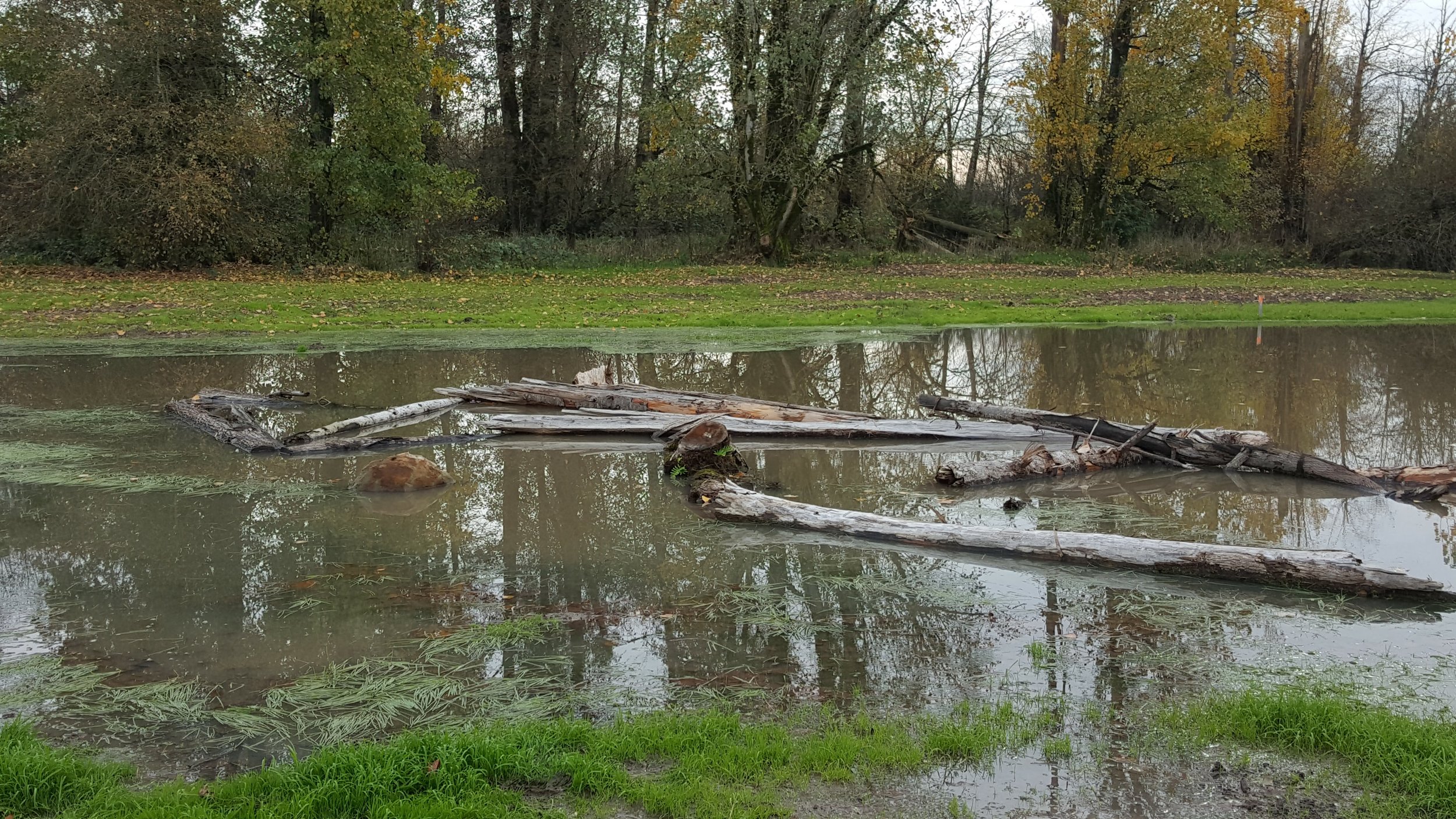
30' x 30' pond


Rain has arrived and is filling depressional pockets within the landscape created by U.S.D.A. NRCS.

Bald eagles find winter home at Santiam Valley Ranch. Geese are a primary target.

Winter returns. Life is enhanced listening to the calls of the geese for the next six months!

2017

Different view on the SW field.

Nelson's checker-mallow (Sidalcea nelsonian) listed as threatened species.
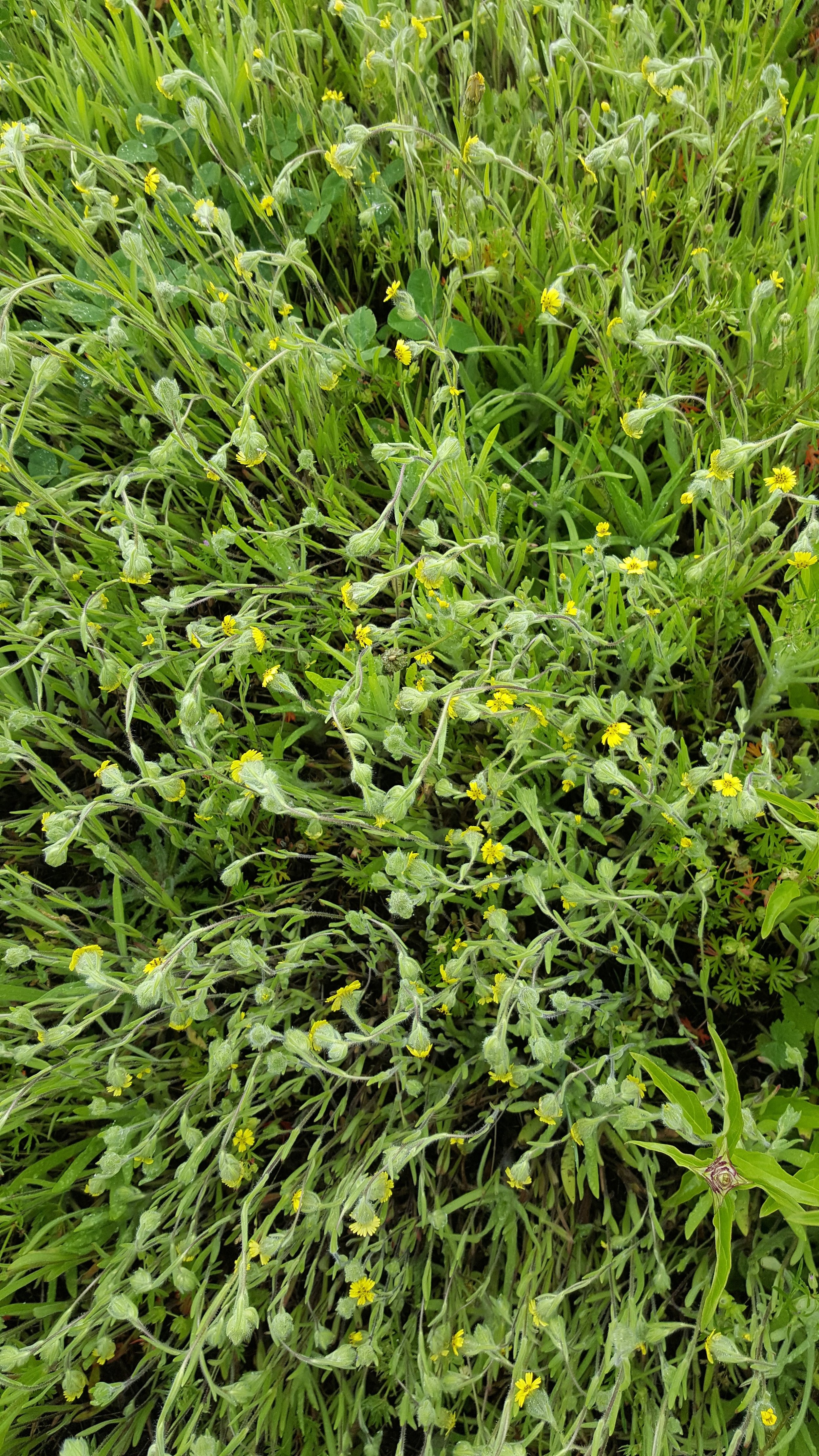

Springtime tour with Cameron King and Chris Seal,
U.S. Fish & Wildlife Service. A raining but very exciting day to see the wetland bloom in the SW field.

July, U.S. Fish & Wildlife Service grading around the turtle ponds. Area around the ponds have been sprayed, awaiting planting of forbs and wetland species in 2018.


On of three 15' x 15' ponds on Santiam Valley Ranch.

Native Wetland Medium to Shallow Water Mix was planted in late fall of 2017. In 2018, you can see the border around the ponds.

2018

Cameron King, USFWS, and Ken are sharing excitement about success in the NE field.
Cameron King, U.S. Fish & Wildlife Service, and Ken enjoy the wetland blossoming on the NE field. Over 26 wetland species have been planted by seeds or plugs creating a diversity of plants, offering habitat for birds and insects. One top priority is to establish habitat for the Western meadowlark, the State Bird of Oregon, which now faces declined populations due to loss of habitat.

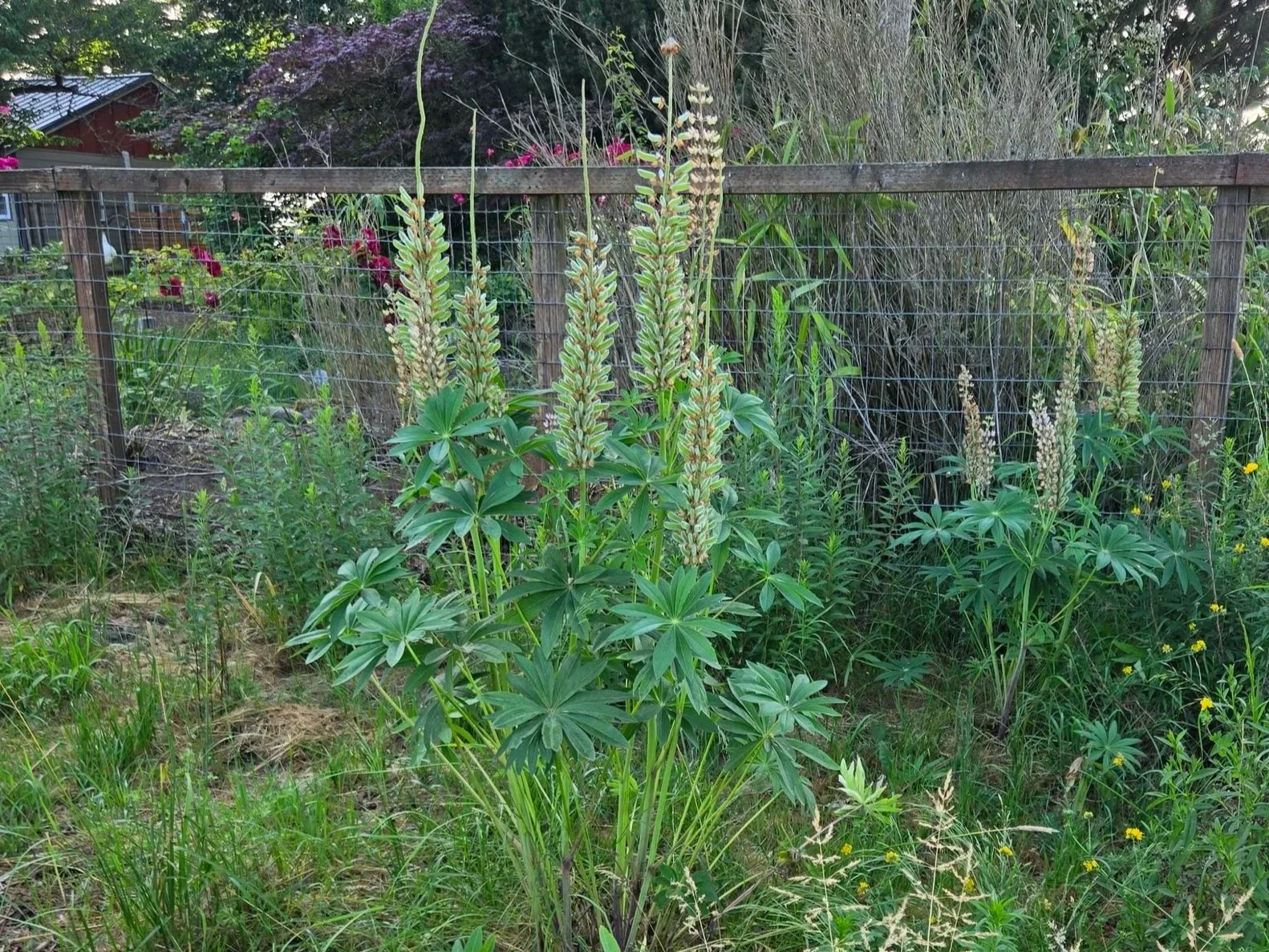
Large-leaf lupine, (Lupinus polyphyllus)
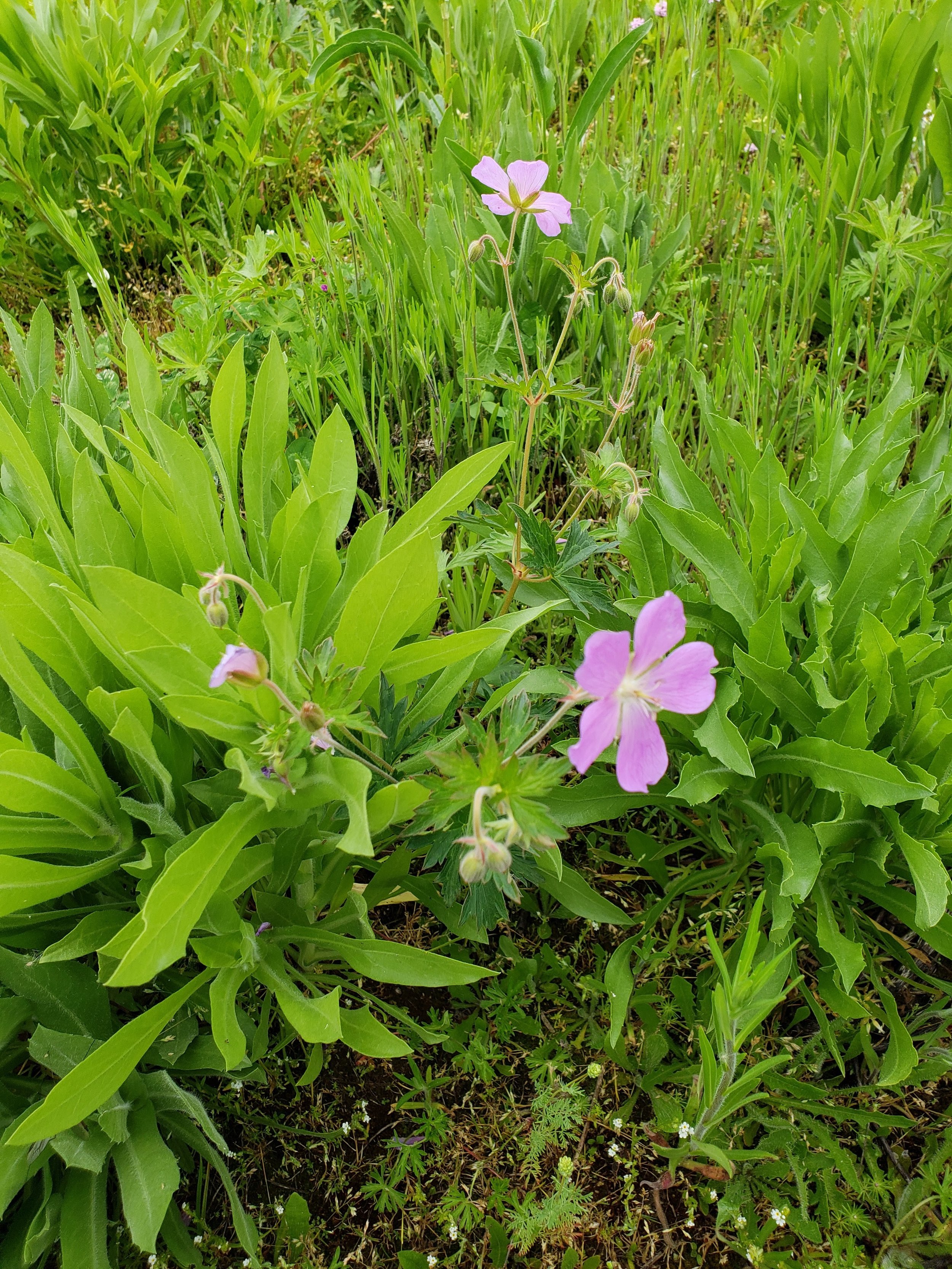
Oregon geranium, (Geranium oreganum)

Ken and Cameron view the hedgerow planted on the east side of the property. The hedgerow is an assortment of plants including Spirea, willows and native wild roses.


Aquatic plants arrive from Balance Restoration Nursery, Lorane, OR

Planting aquatic plants in north pond with Wapato emerging.

American brooklime
(Veronica americana)

Luke holding Yellow pond lily,
(Nuphar lutea)

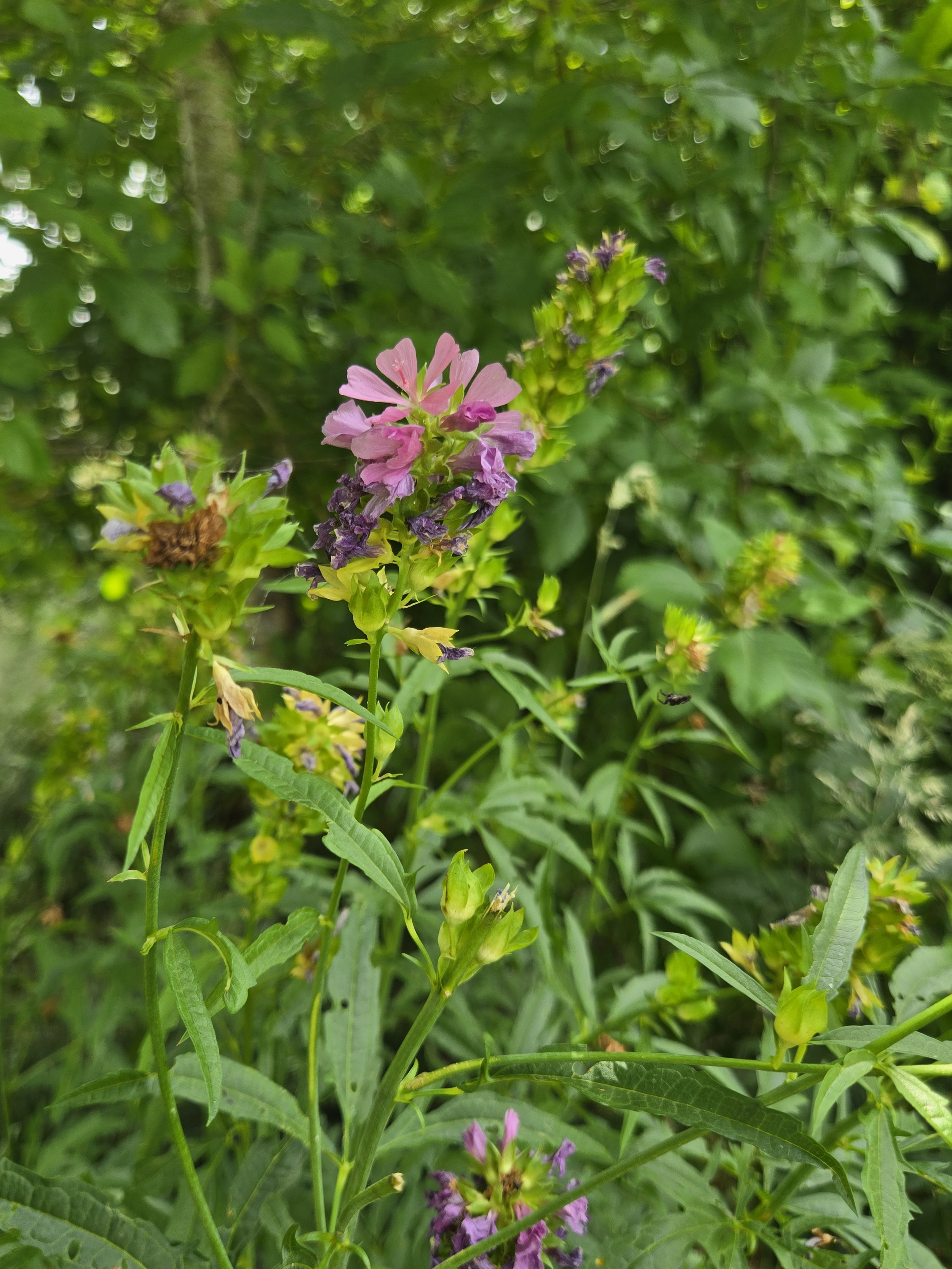
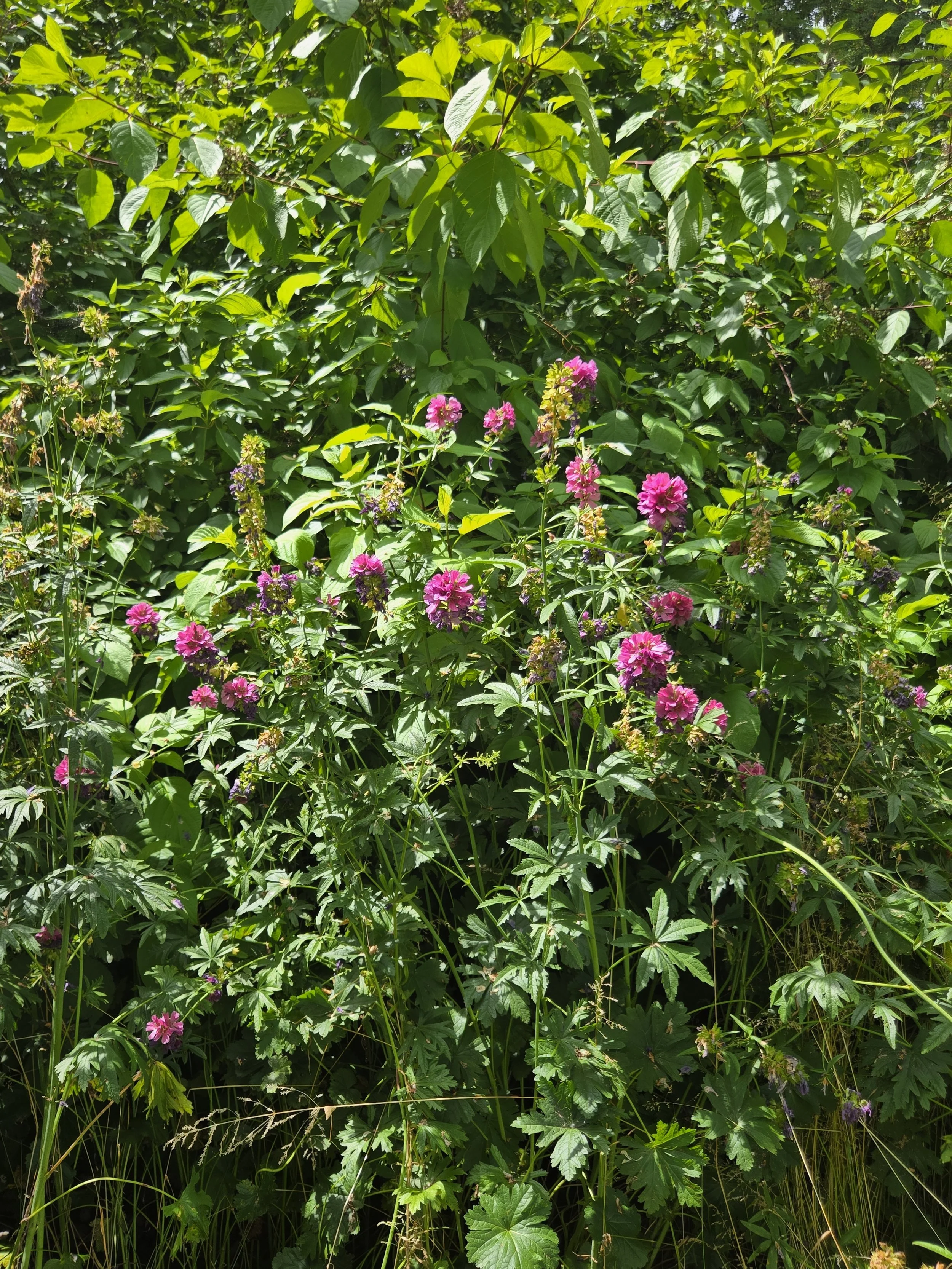
Meadow checkerbloom, AKA Meadow checkermallow (Sidalcea campestris).

Dock, (Rumex spp.)
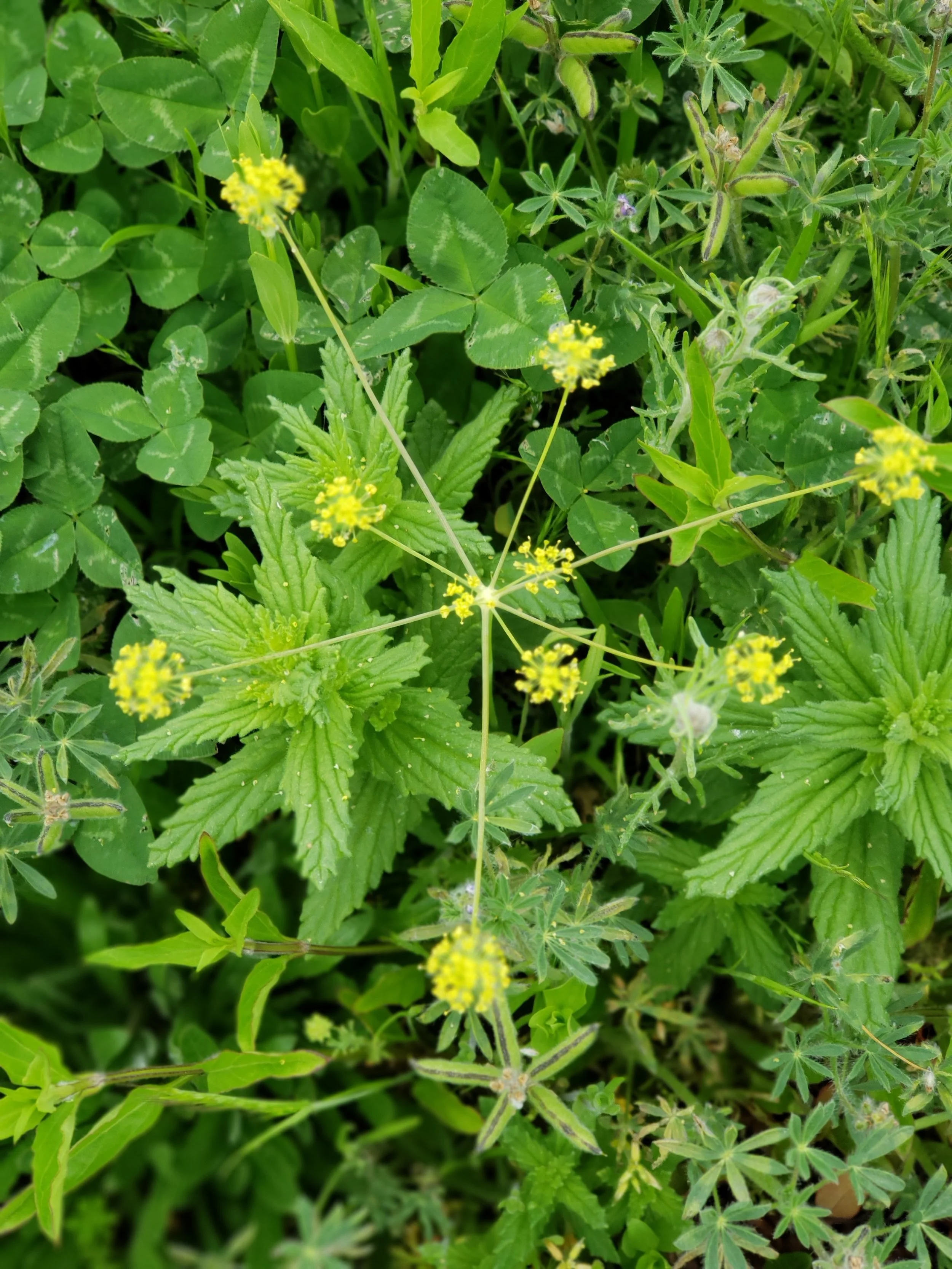
Bradshaw's lomatium, (Lomatium spp.) listed as endangered species.

Narrow-leaf blue-eye grass, (Sisyrinchium idahoense)

White pelicans visit Santiam Valley Ranch.
Turtle Project Continues
The acreage within the Santiam Valley Wetland Enhancement Project has been treated twice with herbicides by U.S. Fish & Wildlife Service, thus preparing for planting in the fall of 2018. In June, aquatic species are planted into the nine ponds: Yellow pond lily,
Oval leaf pondweed and American brooklime.
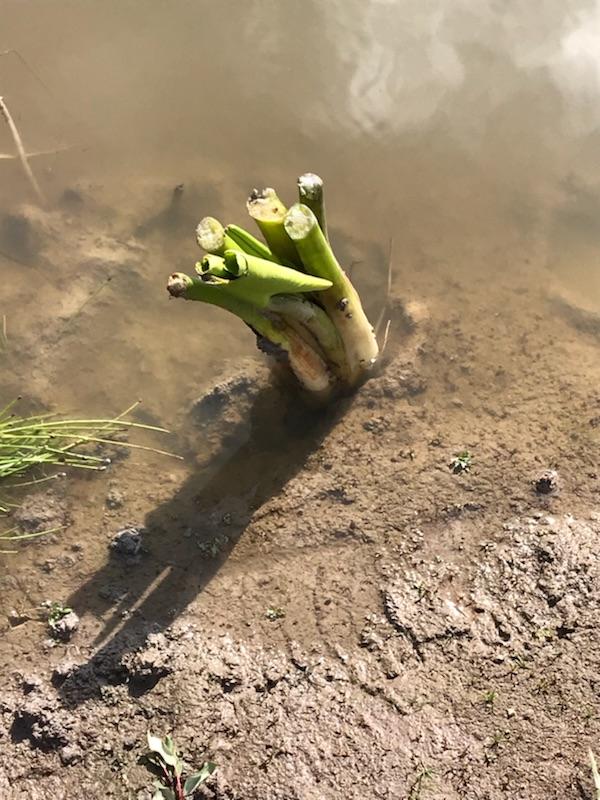


Wetland Restoration Expands: The wetland restoration program begins to address smaller fields that have not yet been restored since efforts began in 2013. Photo below is of two smaller fields adjacent to the Santiam Water Control District's irrigation ditch (on the left). Here, Reed canary grass is mowed. Further efforts will convert this area back into native wetland species.

Photos below are of another smaller field, known as the "8 acres," which lies on the west side of the farm. Here, restoration work is just beginning. In August, Reed canary grass is mowed. On the left of the fence you can see unmowed Reed canary grass, which exceeds six feet in height.
The 8 acres contains trees planted by our sons, Andy and Luke, nearly twenty years ago. Our goal at that time was to provide shade and create habitat that would reduce the introduction of Reed canary grass. The field was pasture and was harvested for hay, primarily Birdsfoot trefoil. Since the wetland restoration work began in 2012, fences were removed and the 8 acres took a lower priority for restoration. Now the unshaded areas are filled with a monoculture of Reed canary grass.
Reed canary grass (Phalaris arundinacea) is a native to Oregon's Coastal environments. There it grows in areas that are irregularly inundated with water; it will not persist under water for an entire growing season. It commonly grows in swamps, lake margins, road side ditches and emergent wetland meadows. Many wildlife species find it attractive for cover, food, and nesting habitats for waterfowl, marsh birds and small animals. Unfortunately, in the Willamette Valley, Reed canary grass is considered an invasive species. It was brought to the Valley to provide erosion control, sediment retention and forage, but regrettably it out-competed other native species.


2019
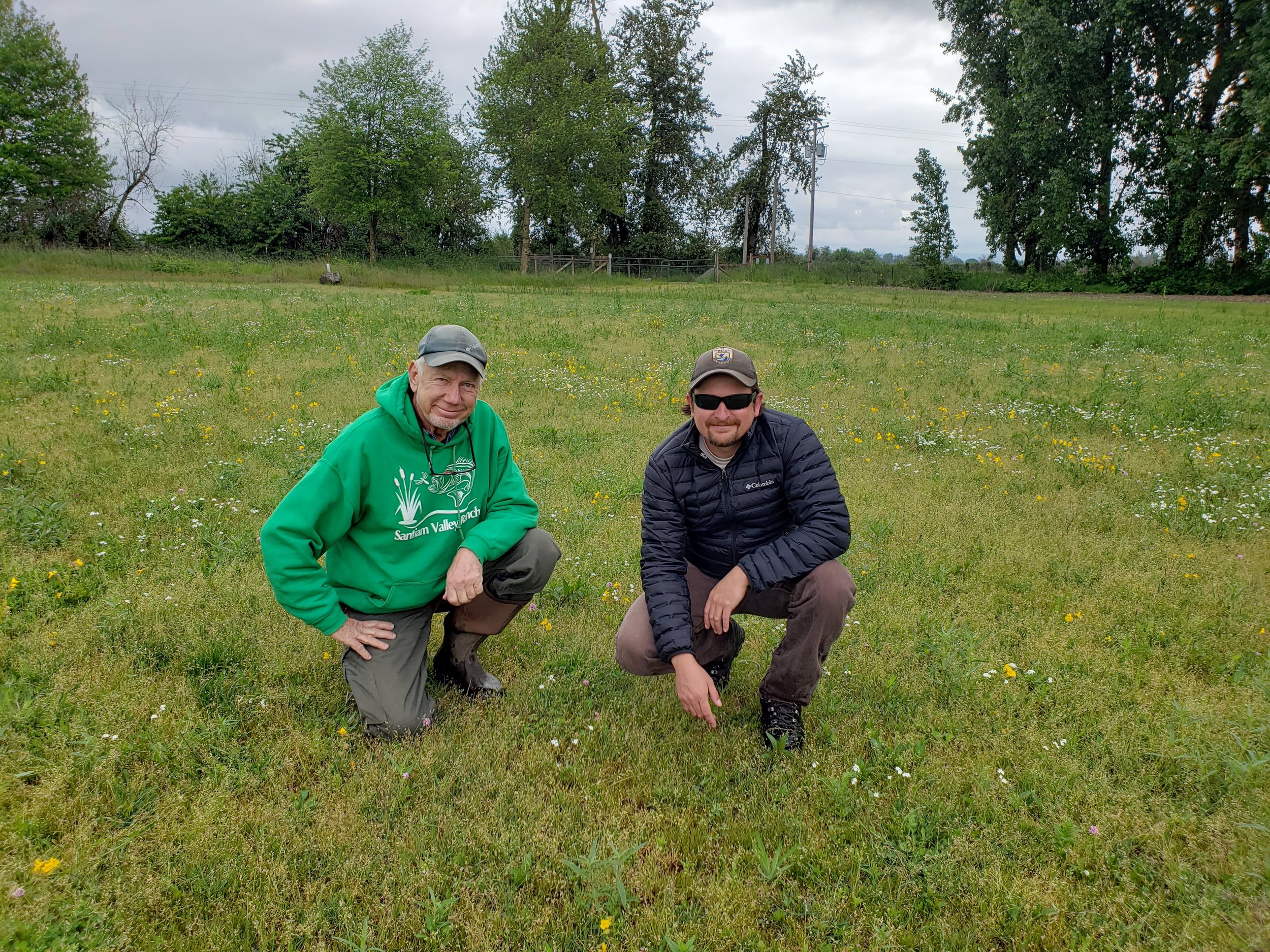
Cameron King, U.S. Fish & Wildlife Service, tours the northeast and northwest fields with Ken and Kathy on May 24, 2019.

Bog birds-foot trefoil or Meadow deervetch (Lotus pinnatus)
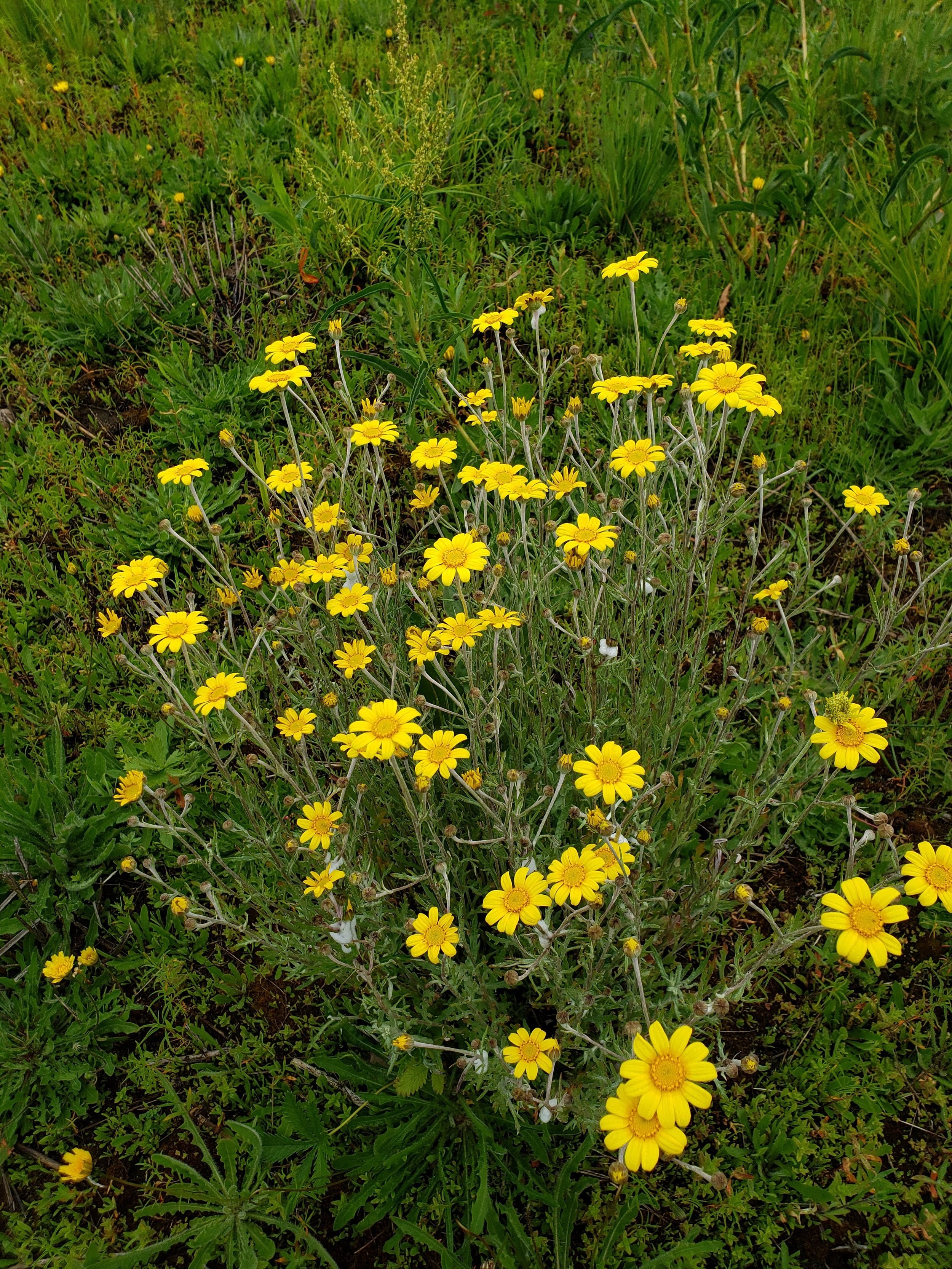
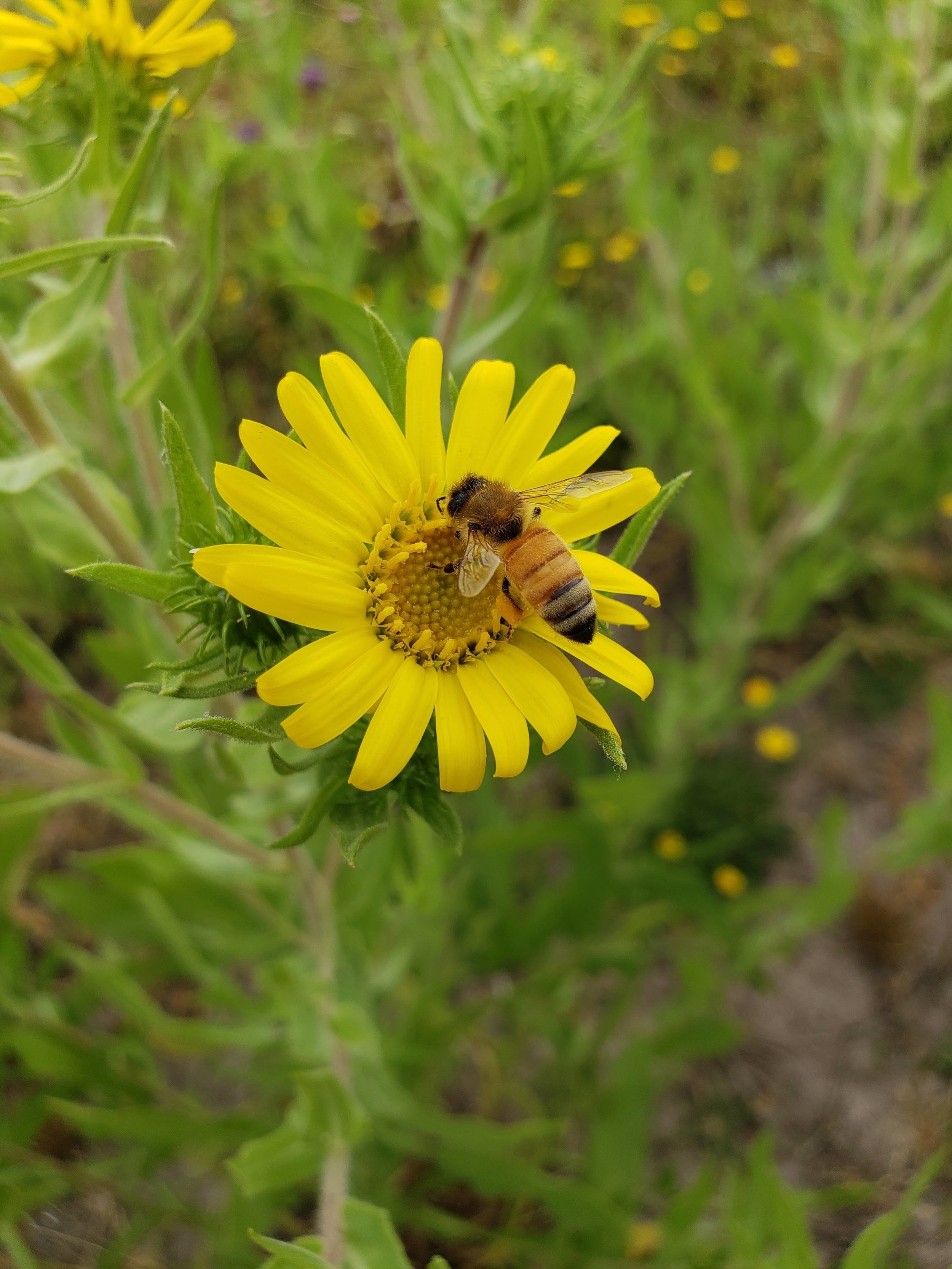
Oregon sunshine (Eriophyllum lanatum)
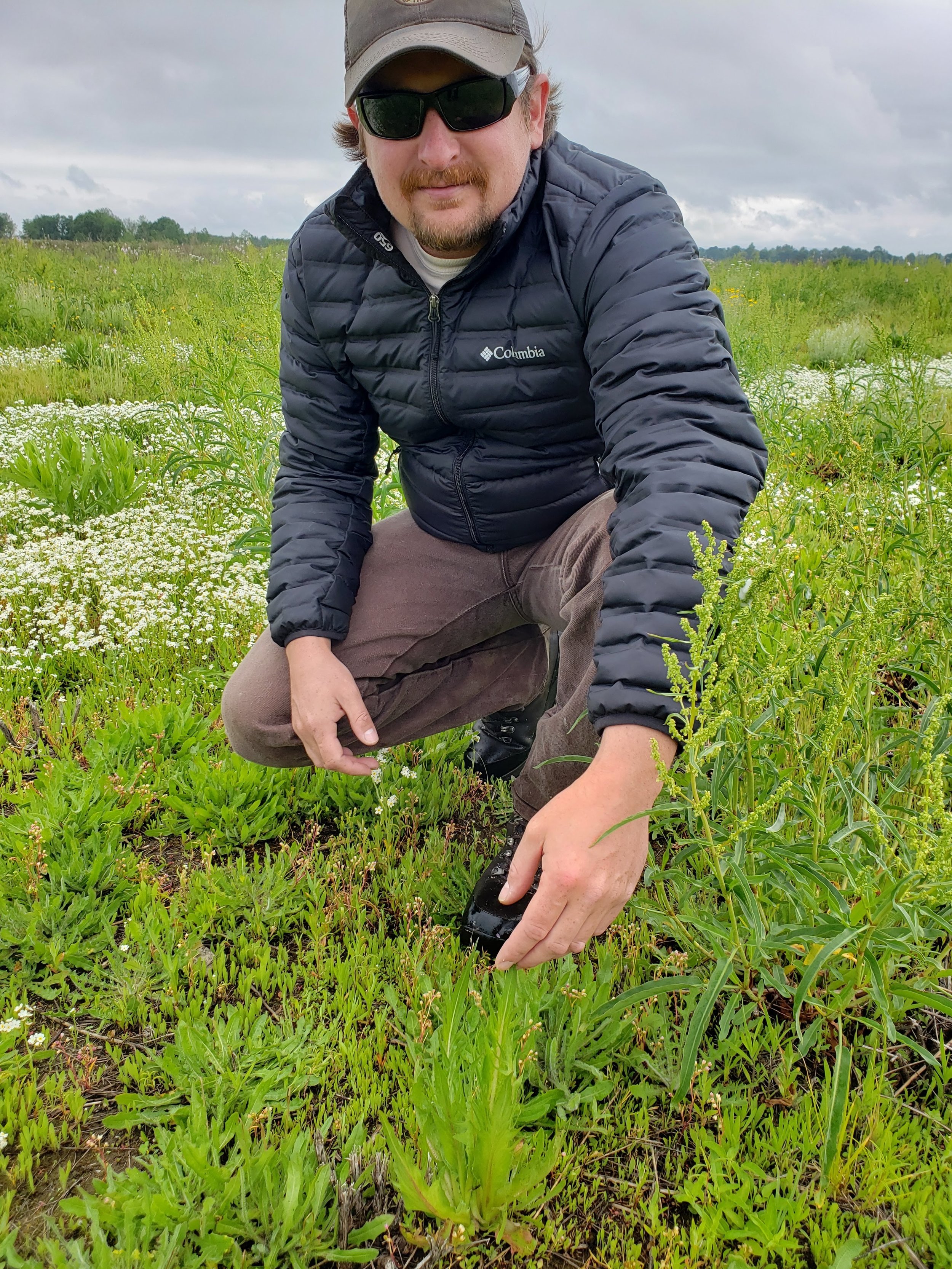
Cameron points out the Cut-leaf microseris.

Meadow checkermallow (Sidalcea campestris)
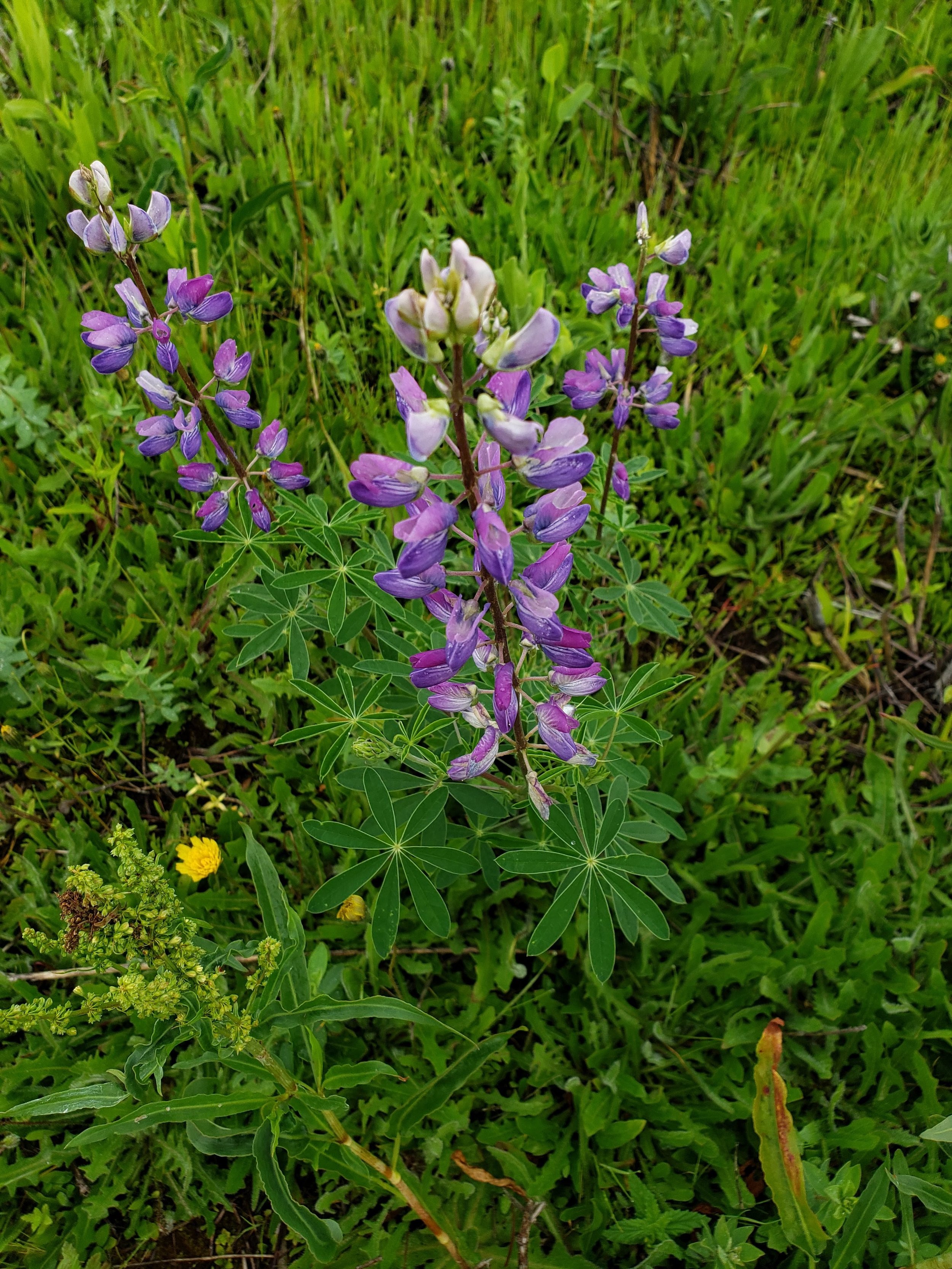
Large-leaf lupine (Lupinus polyphyllus)

Large-leaved avens (Geum macrophyllum)

Cutleaf silverpuffs (Microseris laciniata)

Bare-stemmed lomatium (Lomatium nudicaule)

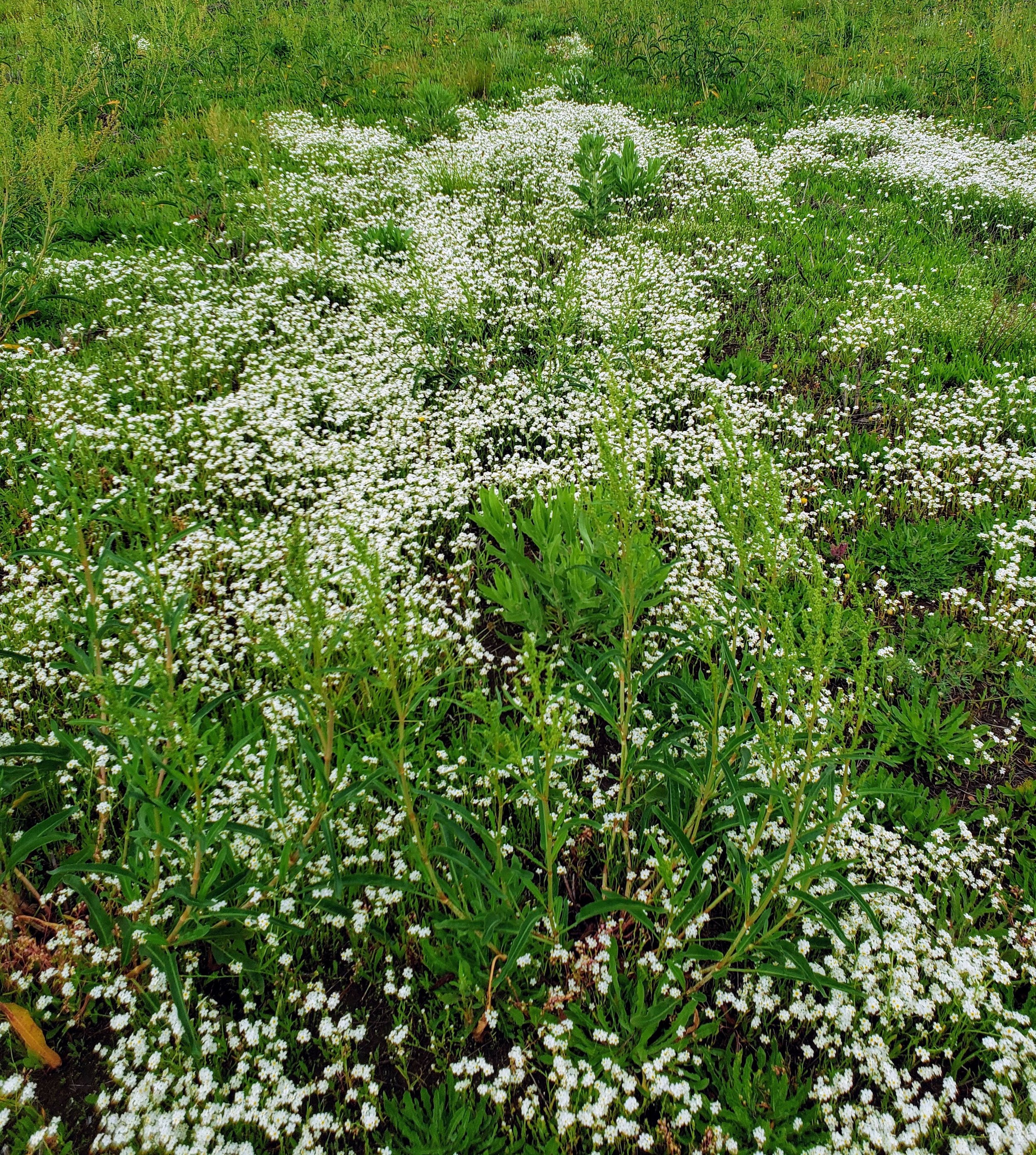
Fragrant popcorn flower (Plagiobothrys figuratus)
It was our delight to share the emergence of the wetland prairie with our good friends, Jane Hartline, Sauvie Island Native Plants and her husband, Mark Greenfield, Audubon Society of Portland.
Mark discovered nesting Streaked-horn lark and spotted a Savannah sparrow. We were all delighted listening to the Western meadowlark. Jane knew all of the plants…and by scientific name. It was an amazing time!

Ken, Jane, Luke Fitzpatrick, Mark and our Sauvie Island buddies, Ray and Katie.

Turtle ponds getting established.


US Fish & Wildlife Service mowed the area on July 19, 2019.


Mowed area, July 19, 2019.
Santiam Valley Ranch, LLC is a participant in the Pollinator Protection Pledge, www.xerces.org


2020
ADDRESSING THE 8-ACRES
The conservation easement includes an isolated piece of land, bordering on the north by the irrigation canal and on the south by the Fitzpatrick Lateral ditch. Both waterway ditches are exempted from the conservation easement due to a previous easement with Santiam Water Control District.
Long ago, the 8-acres was a pasture and was hayed in the summer. The decision was made to convert the area to trees. All members of the family, and others, worked away planting trees. Over several years, Willamette Valley Ponderosa pine, Big-leaf maple, Oregon ash and Black cottonwoods took hold, along with other trees, including Coast redwood. Regrettably, with the field not being grazed or hayed, the invasive Reed canary grass moved in and began to dominate. And an occasion beaver would visited, taking a toll on their favorite food — maple.
This area, after 15 years, is now emerging as wildlife habitat. The consensus with NRCS and the conservation easement is to protect and expand trees. Their shade will reduce the optimum habitat for the Reed canary grass and create an environment for owls and other birds.
Reed canary grass grows up to 7-8’ in height. Once it dominates, it basically overtakes the area. To begin to address this, in 2019, NRCS allowed for sheep to graze the field with the goal of controlling the Reed canary grass and to allow for further planting of trees.
In April, 2020, sheep were introduced to being rotational grazing.


Introduction of sheep on April 10, 2020.

Reed canary grass after five days of grazing.
Annual Monitoring of the Santiam Valley Wetland Enhancement Project, also known as the Turtle Ponds, May 9, 2020. Oregon has experienced quite a bit of rain during the springtime. The pond next to the irrigation ditch is still receding. Many thanks are given to Cameron King, US Fish & Wildlife Service for help in identifying the plants, and to our son, Andy Fitzpatrick and to Kendra Kutina for their assistance in collecting data.
Annual Monitoring Report May 2020 for Large 30 x 30 Pond (PDF)
Annual Monitoring Report May 2020 for Five Smaller 10 x 10 Ponds - Part 1 / Part 2 / Part 3 (PDF)

2021
The wetland continues to excite all!
In 2021, Santiam Valley Ranch thanks Cameron King, USFWS, for an annual tour of the project. We hosted several guests at the tour. Cameron also provided a complete plant list for the WRP properties.
Like-minded folks are viewing and recording bird count and insects, primarily bees. Wetland ecologist, Paul Adamus, PhD, is compiling an annual bird count. He also tabulated the e-bird count, which is now available on the home page of Santiam Valley Ranch.
Stephanie Hazen and Ray Temple will begin recording native bees in 2022. Thanks to Ray, Santiam Valley Ranch will be working with Salem Audubon Society to craft raptor perches and raptor nesting boxes.
The WRP ground was scheduled to be burnt in the late fall of 2021, which is consistent with how the land was maintained by the indigenous people that once lived here. The burn would keep out trees and shrubs and instead would nurture and maintain the open prairie. Unfortunately, the burn did not occur.
All in all, it is a joy to see a quiet and serene place providing undisturbed habitat, allowing an opportunity for flora and fauna to take root and enjoy a permanent home.

May 3. Wetland tour led by Luke Fitzpatrick with Paul Adamus and Sandy Stutey.
Photos below are from the eight acres. This area was mowed, getting ready to plant trees in the future.


Photos below are from the turtle ponds.
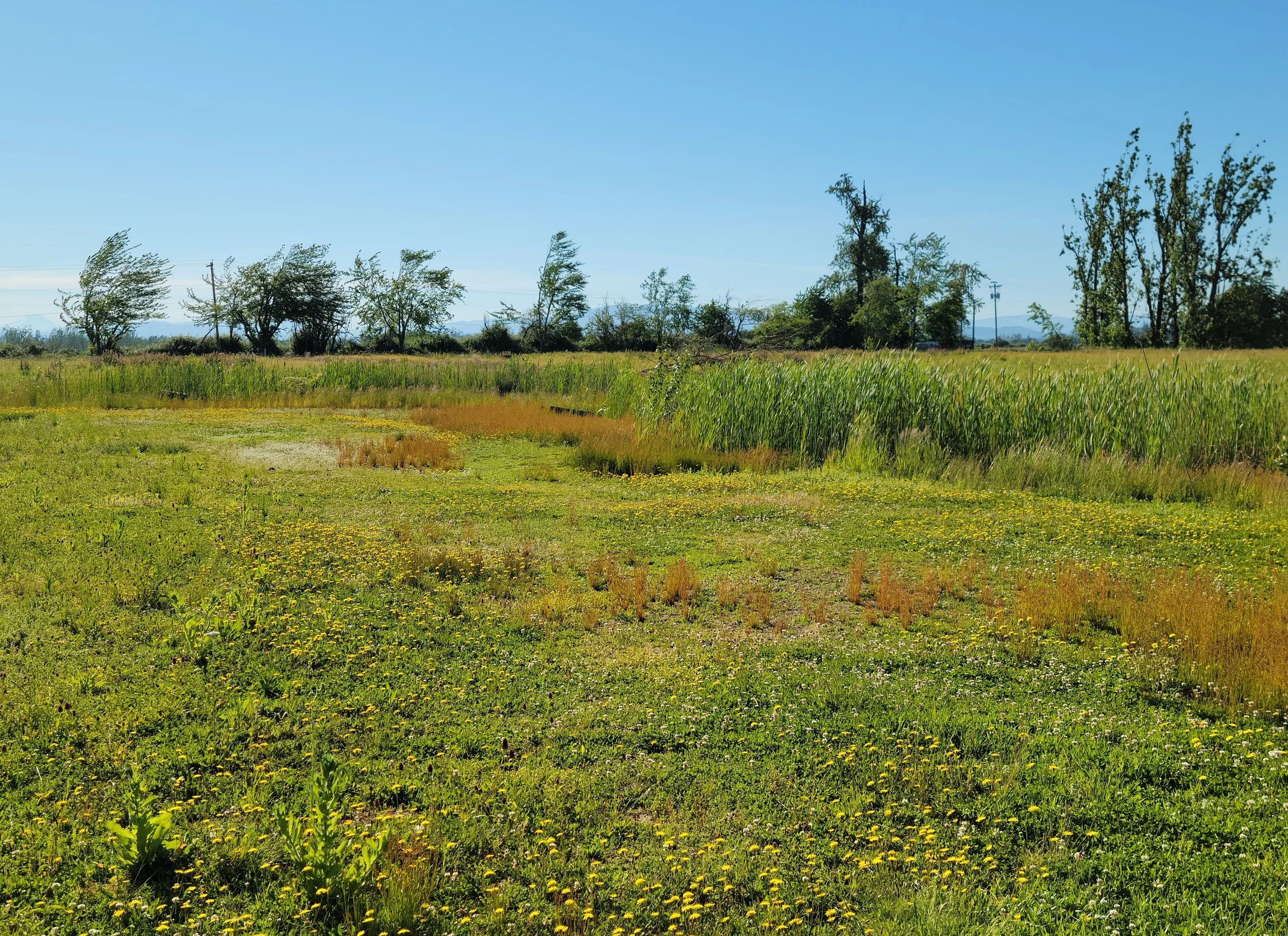
Following is the Plant Species List used by U. S. Fish & Wildlife Service for the Wetland Reserve Program.
Following is the Oregon Division of State Lands Annual Monitoring Report for 2021.

June 21. Wetland tour led by Cameron King, USFWS.

Note how the beaver cut down the maple tree and how amazing it is that the maple tree grew back ten-fold! It looks like beavers and maple trees get along quite nicely.


2022
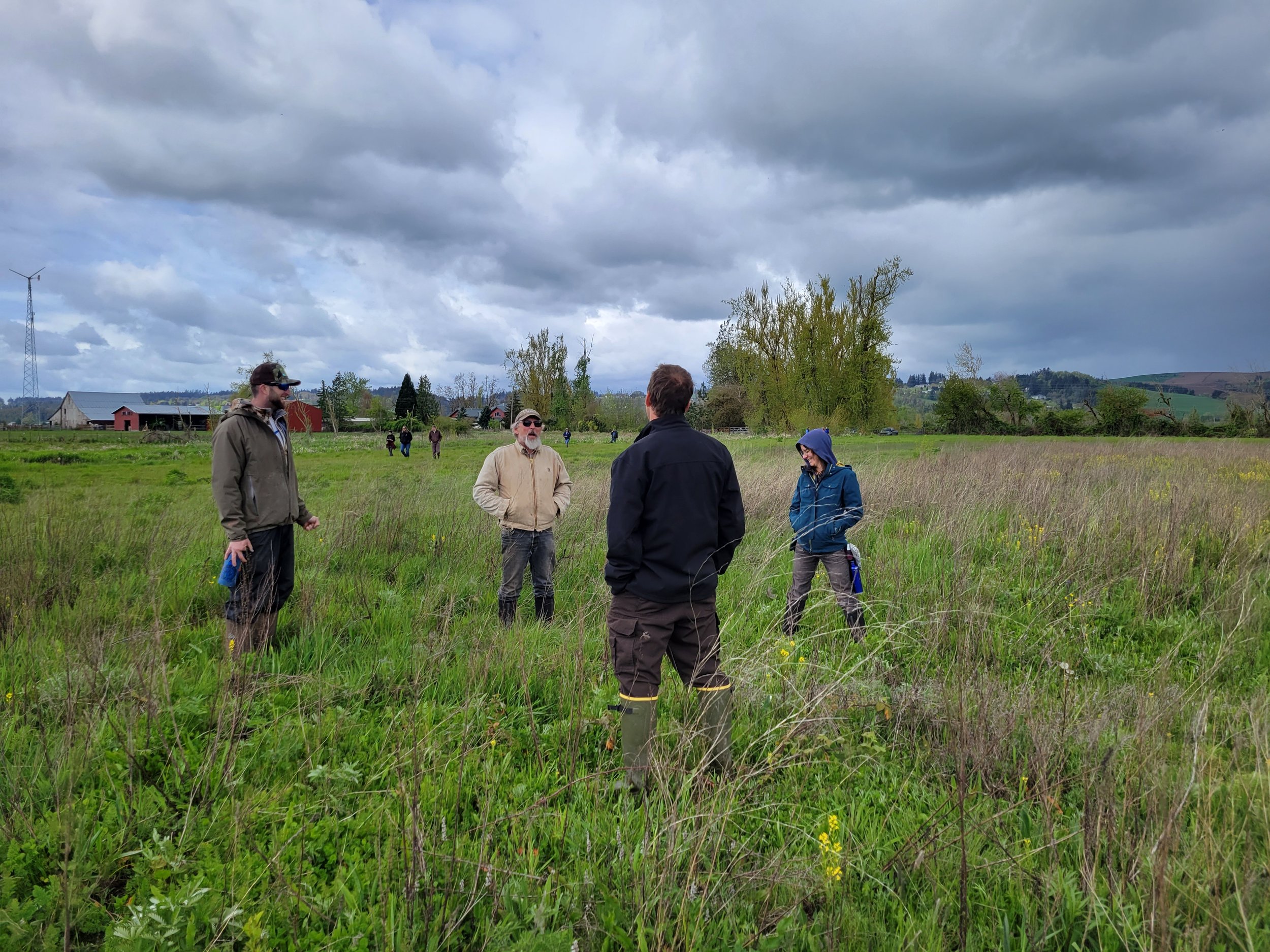
Wetlands Tour: On April 26, 2022, Santiam Valley Ranch hosted an on-site wetlands tour led by Chris Seal and Jon Campbell, U. S. Fish & Wildlife Service. Regrettably, because of the late rains and cool conditions, the wetland plants were experiencing a 4–6-week delay.
Oregon Division of State Lands Annual Monitory Report for the Turtle Ponds: On June 1, a review of the Turtle Ponds was prepared which gives an overview of plant species on the NW field. Following is the Oregon Division of State Lands Annual Monitoring Report for 2022 which includes description of the Wetland Tour and a Status Report on the Turtle Ponds.
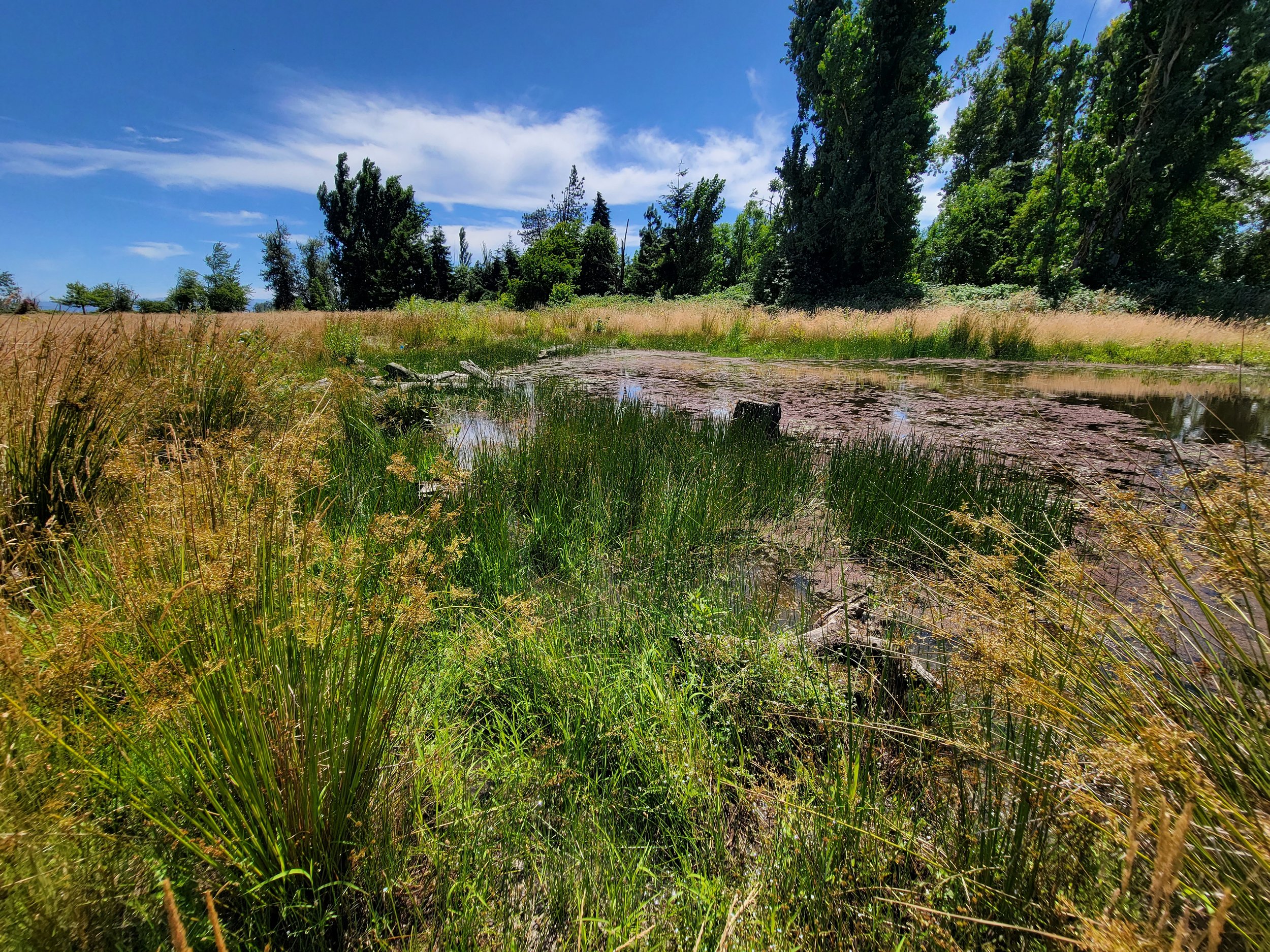
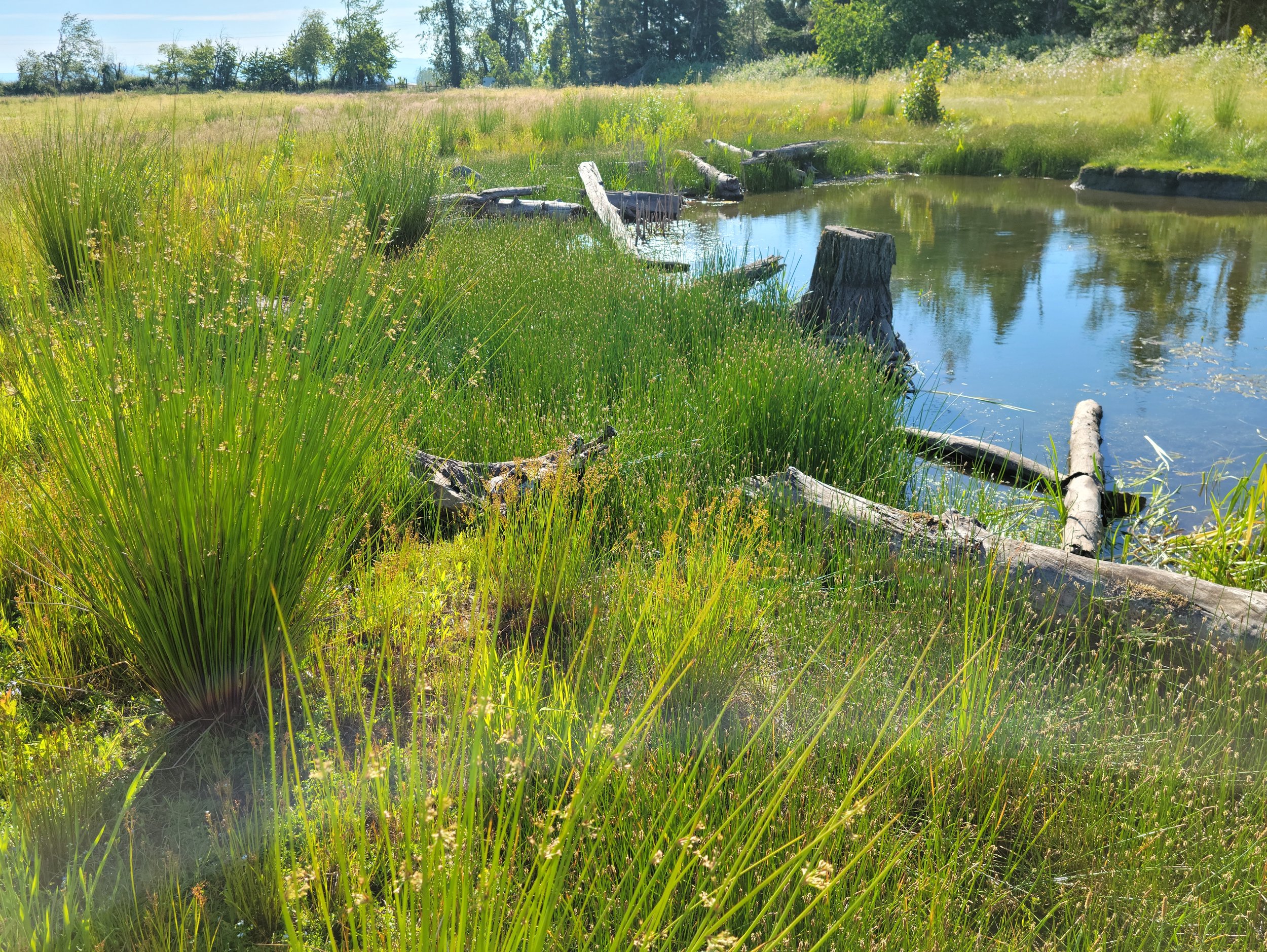
Turtle Pond with one large pond (July 13).
Restoration on Areas Not Addressed by NRCS Since 2012:
In 2021, Santiam Valley Ranch was asked to prepare three proposals:
(1) Plant hedgerow along Hunsaker Road with the goals to provide security, seclusion, wildlife habitat and improve the overall landscaping design to minimize invasive plant species coming from adjoining properties.
(2) Restore 8 acres on the west NRCS field with the goal to minimize and impede the growth of Reed canary grass by grazing and altering the overall ecosystem by planting a 175 heterogenous stand of native trees. Tree planting work would be contracted to R. Franco Restoration, Inc.
(3) Restore 3 acres on the south side of Santiam Water Control District irrigation ditch which maintains a 15’ easement abutting the NRCS field, with goals to dominate the area with a 70 heterogenous stand of native trees and shrubs. Tree and shrub planting work would be contracted to R. Franco Restoration, Inc.
All three of the proposals were denied on April 28, 2022. In addition, NRCS mandated that any work previously done on the hedgerow be removed to which Santiam Valley Ranch firmly objected based on discussion dating back to 2012. Santiam Valley Ranch requested NRCS to address restoration of these sites before the interagency agreement with USFWS expires OR to coordinate with the Landowner about the future restoration and future management of these sites. As 2022 ends, Santiam Valley Ranch has yet to receive a response from NRCS.
Burn: Efforts were made, again, in 2022 to burn the NRCS areas. Because of the late rains, the wetland filled up with Velvet grass and other grasses. The added turf should be burnt to optimize habitat for wetland plants and to minimize growth of invasive grass species, shrubs, and trees. Santiam Valley Ranch contacted the Turner Fire Department, to which they noted that NRCS is in-charge of the burn and NRCS does not rely on decisions made by the fire department. The fire department suggested to us that NRCS inform area residents about the burn, either before the burn or respond to inquiries at the time of the burn. Unfortunately, the burn in 2022 did not occur.

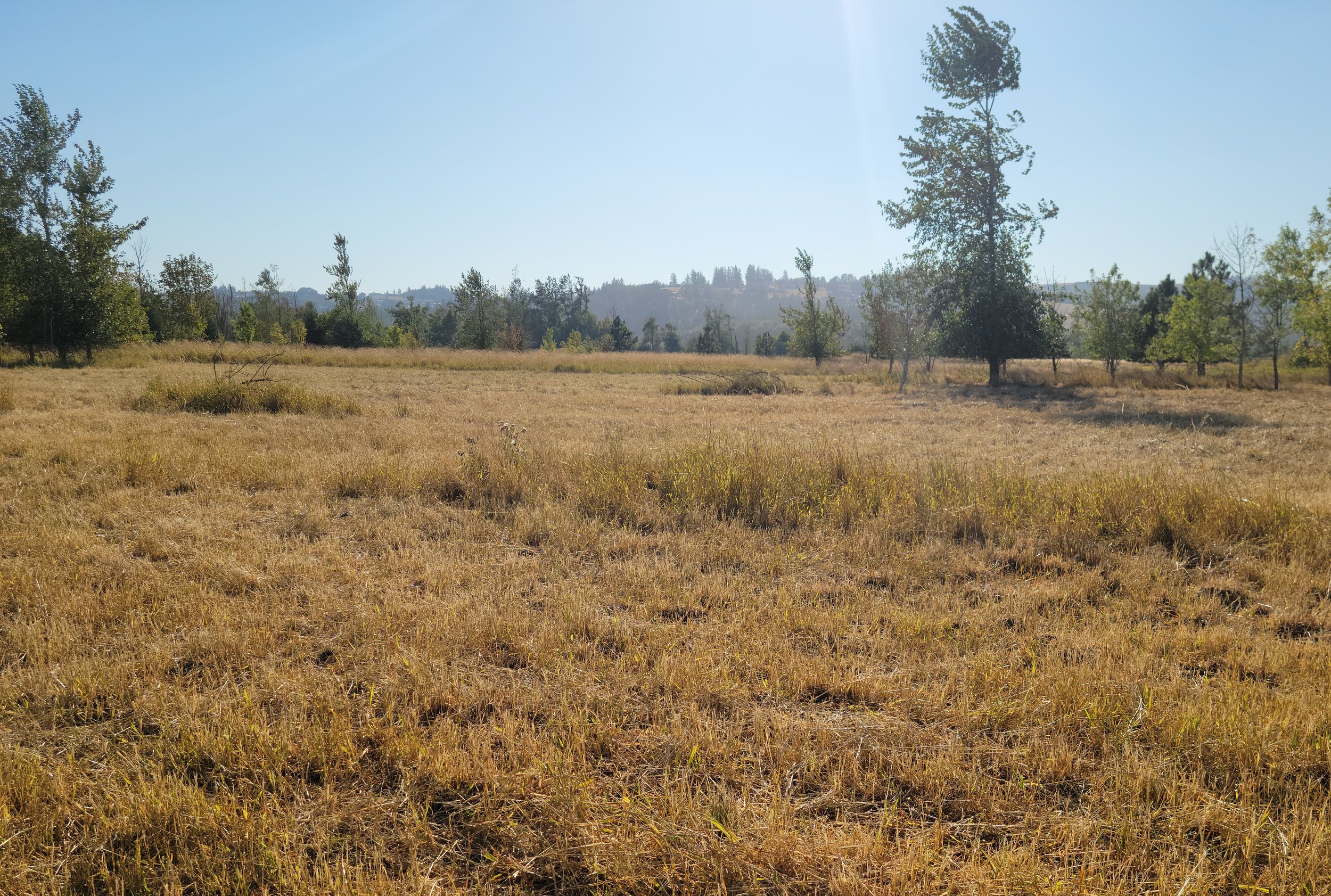
One can see the extent of grass that dominated the prairie due to extended rains and cooler temperatures during February-April.


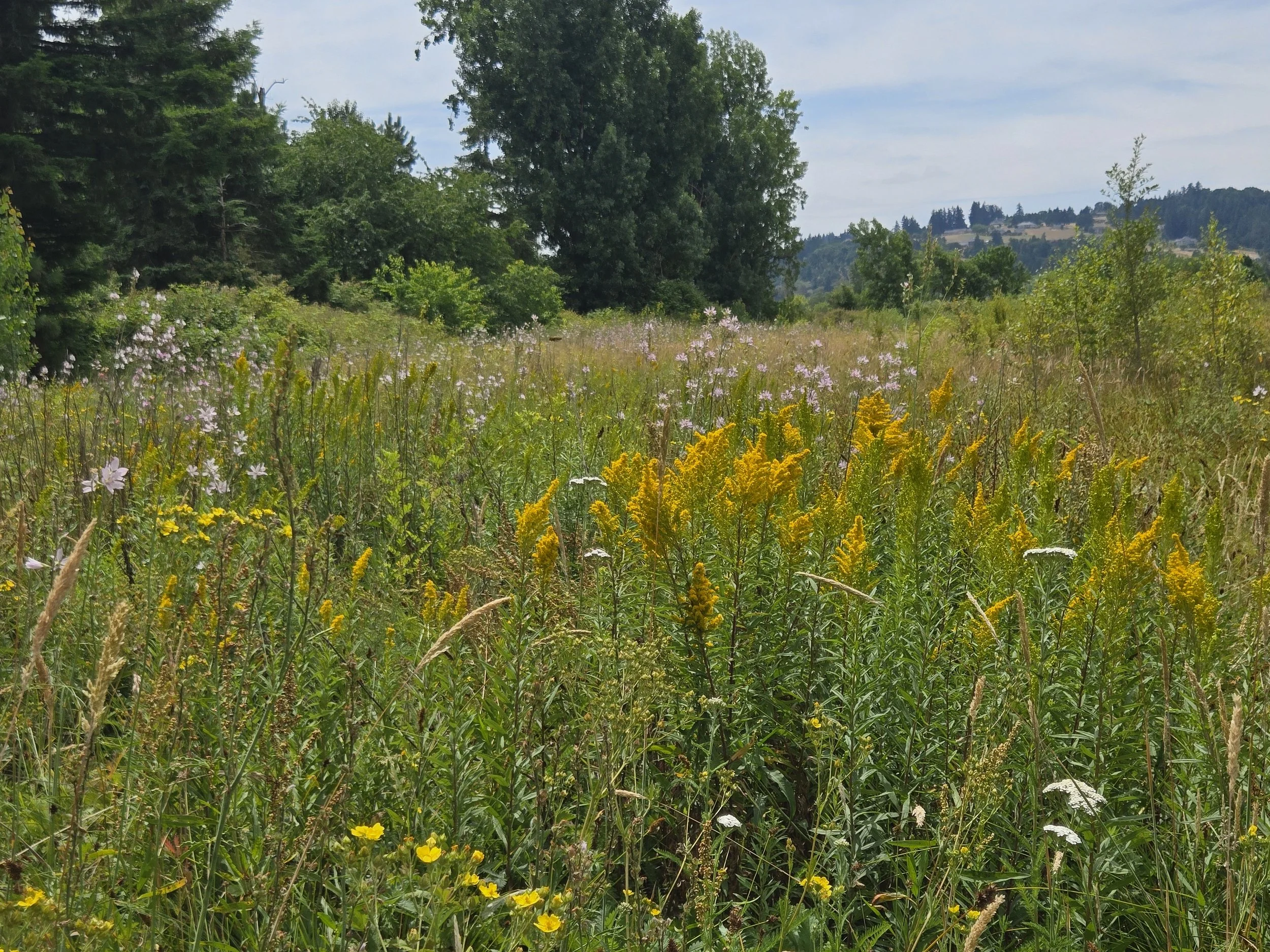
Blossoms emerge, June 2022

Turtle Ponds with five smaller ponds (July 13).
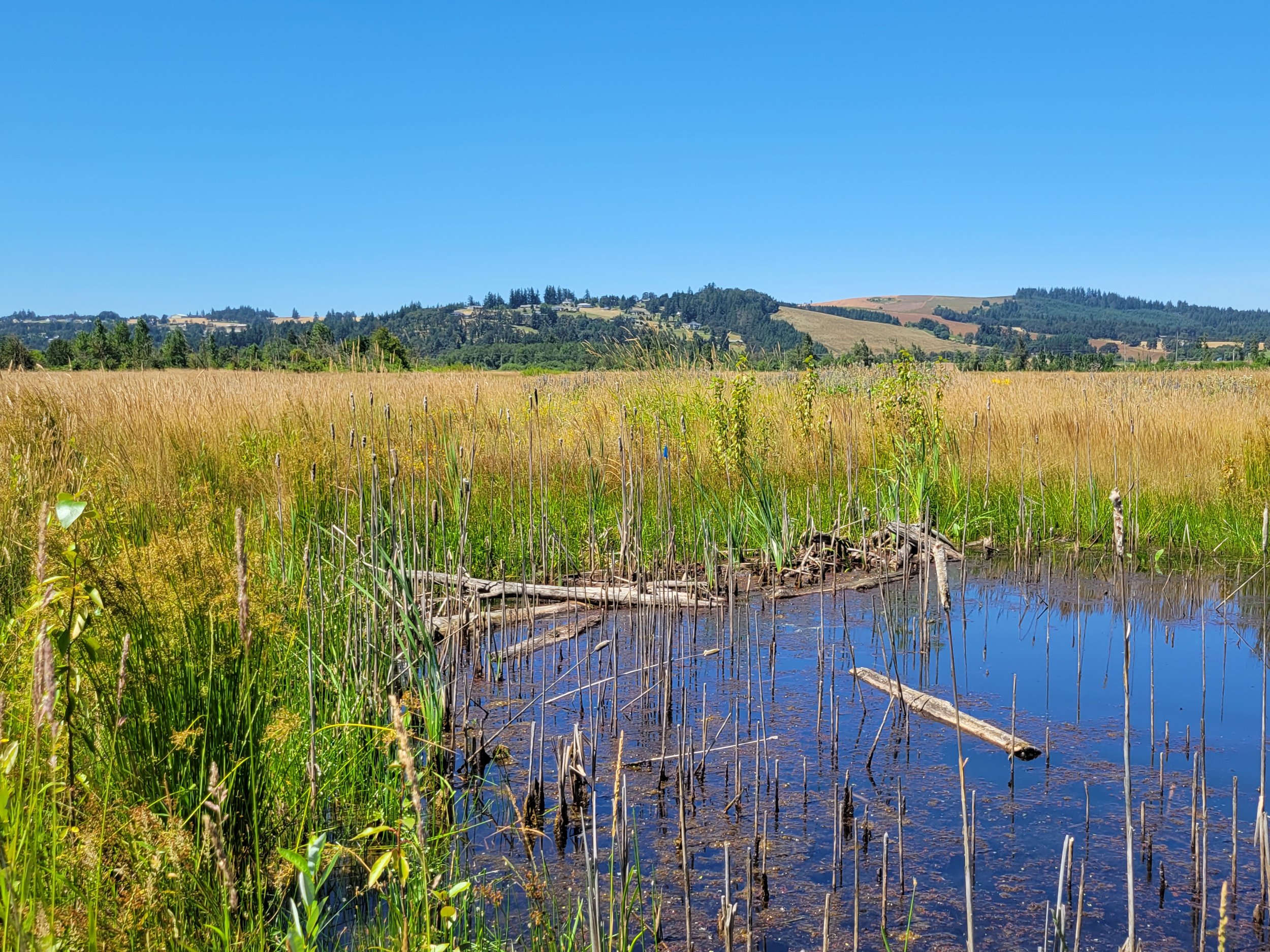
Turtle Ponds with three ponds (July 13).
Bird Nesting Habitat: In 2021, Santiam Valley Ranch was asked to prepare a proposal to expand bird nesting on the NRCS. Bird nesting boxes were to be placed around the perimeter of the prairie so as not to interfere with USFWS mowing and planting. Santiam Valley Ranch worked with the Salem Audubon Society and submitted a 2-year design and budget. The proposal was denied on April 28, 2022.
Biological Thistle Control: In 2021, Santiam Valley Ranch learned about biological control for Canadian Thistle, which is a major problem on the 8 acres NRCS field. Biological control includes Canada Thistle Stem Weevil, Canada Thistle Gall Fly and Canada Thistle Rust Fungus. Kathy worked with Oregon Department of Agriculture (ODA) and efforts were made to initiate biological control in September of 2022. Unfortunately, just before the stocking time, ODA felt that the state agency would not stock biological control on “private property.” And so, with that, we venture forward. ODA noted that the herbicide, Milestone, is effective against Canadian Thistle. Kathy also learned there is a biological control for Bull Thistle known as Seed Head Gall Fly. There are private producers that grow and sell biological control for thistles.

U.S. Fish & Wildlife Service mowed perimeter of the NRCS area in preparation for burning. This photo was taken September 12.

2023
Birds, Flowers & Bees Wetland Tour, May 31, 2023
Hosted by Santiam Valley Ranch
Nearly 30 passionate folks attended the wetland tour, led by Dominic Valenti and Shane Pruett for a Birding Tour beginning at 7:30 AM. This was followed by Lynda Boyer, Resto-ration Biologist with Heritage Seedlings who gave a truly inspirational knowledge and in-sight in identifying wetland plants and their importance to the environment. Following lunch, Stephanie Hazen presented an incredible venture into the world of native bees via her slide show and assortment of publications. It was a delightful time to spend meaning-ful time together, understanding the importance of wetland habitat restoration and its im-pact on birds and insects.

Above and below, birding at Santiam Valley Ranch.


Above, birding at Duck Flat Flyway.

The tour spanned several contiguous properties protected through the USDA Wetland Reserve Program: Santiam Valley Ranch, Duck Flat Flyway and Smith Family Trust.

Viewing wetland plants at Santiam Valley Ranch.


Stephanie Hazen discusses native bees on the wetland.

Native bee presentation from Stephanie Hazen.

Lynda Boyer—enthusiasm and knowledge!

Viewing wetland plants at Smith Family Trust.
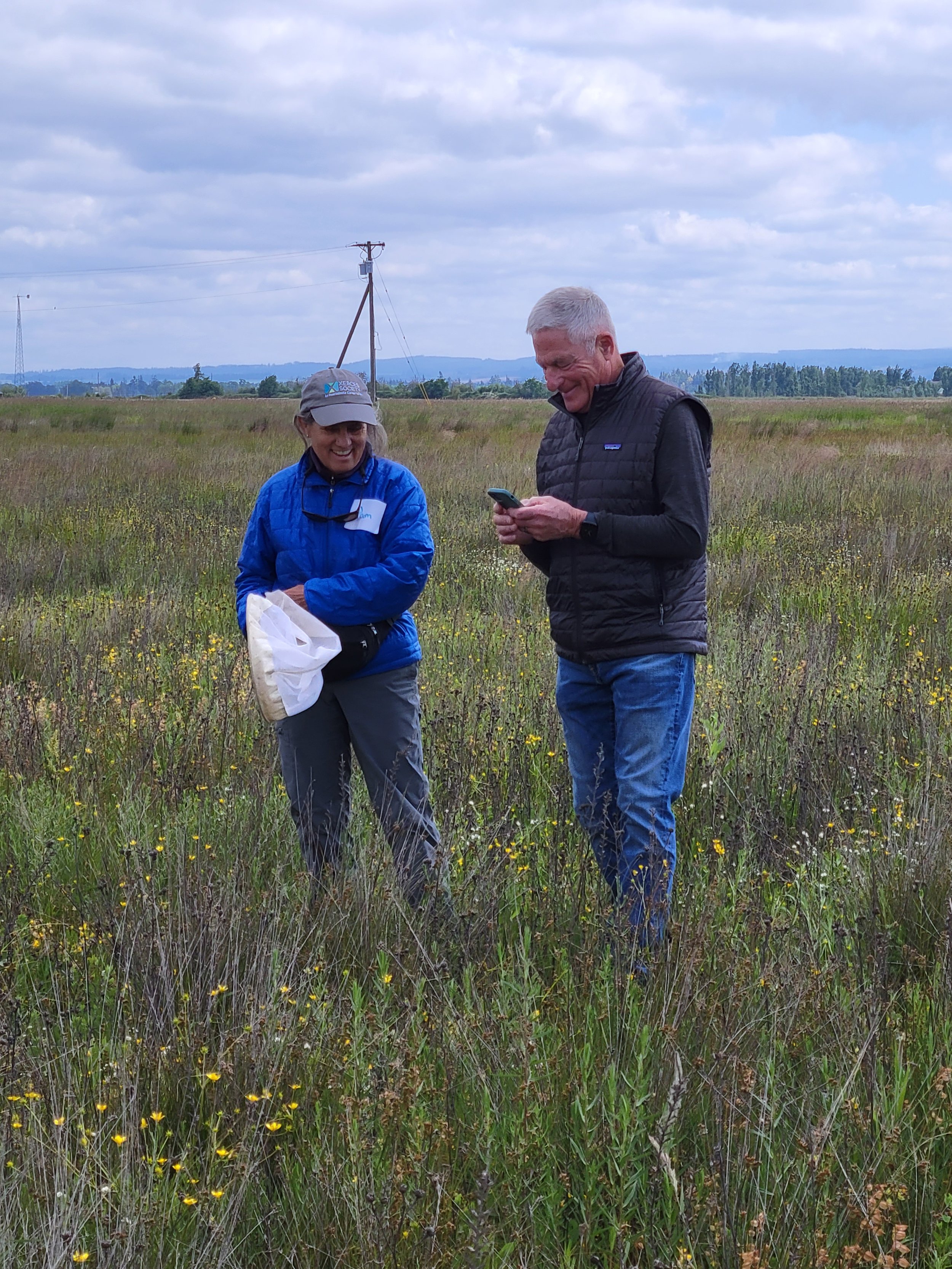
Native bee collecting. Pam Hayes, Oregon Bee Atlas Project, with Dean Smith.
2024
Final Report on the Turtle Project to Oregon Department of State Lands
Prepared by Paul Adamus, PhD
Copy of Final Monitoring Report for Kathy Bridges Turtle Ponds, July 10, 2024 (PDF)
Copy of Mitigation Monitoring — Vegetation Data Template (PDF)

Paul Adamus, PhD, monitoring the Turtle Ponds, July 7, 2024
2025
Prescribed Wetland Burning: Santiam Valley Ranch
Project Overview and Challenges
For the past decade, efforts have been underway to implement a prescribed burn across 96 acres of the Wetland Reserve easement at Santiam Valley Ranch, as well as on 310 adjacent acres. In 2024, a formal agreement was signed with the U.S. Fish and Wildlife Service to oversee the burn in coordination with the USDA Natural Resources Conservation Service.
However, despite these plans, the project was abandoned in 2025. This was due to a lack of manpower and supervision following the layoff of 280,000 federal employees by the Department of Government Efficiency (DOGE) earlier that year.
The Ecological Necessity of Fire
In the Willamette Valley, prescribed fire is an essential component of fire-adapted wetland ecosystems. This management tool mimics natural processes and honors the land management protocols established by Native Americans in this region over the last 10,000 years.
The implementation of seasonal fire provides several critical environmental benefits:
Wildfire Prevention: It reduces fuel buildup, preventing more intense and devastating wildfires.
Habitat Restoration: It improves local habitats by removing overgrown vegetation, known as thatch.
Wildlife Support: It creates open water areas essential for waterfowl, migratory birds, and other native wildlife.
Regeneration: It exposes the soil to facilitate the germination of native seeds.
Soil Health: It releases vital nutrients back into the ecosystem.